
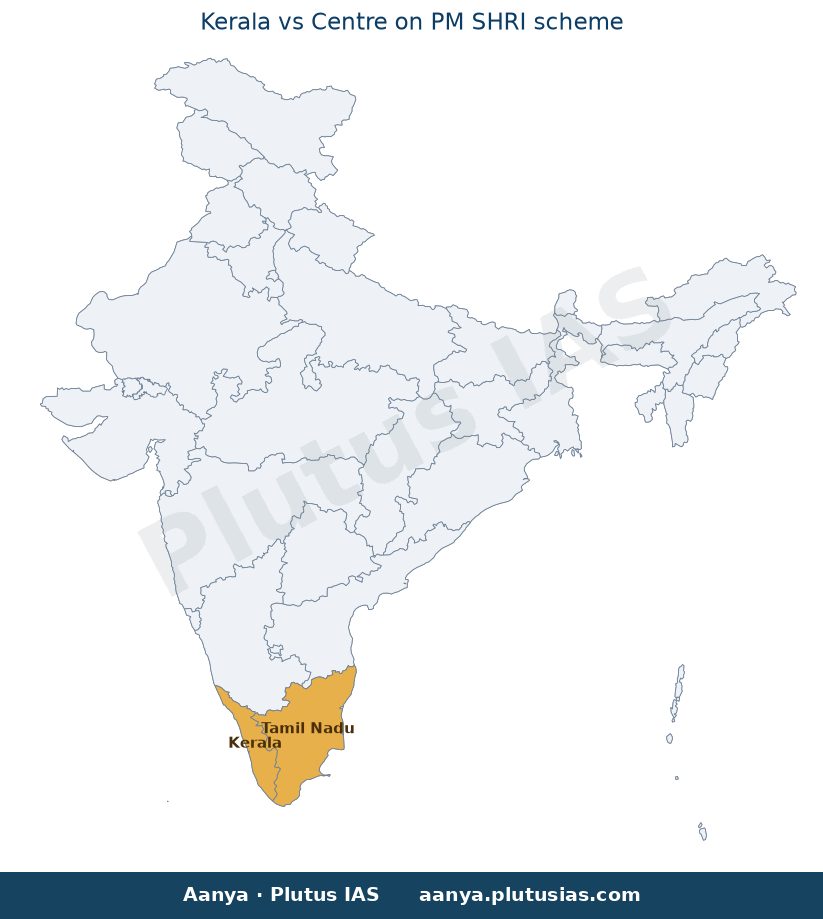
✎ Kerala's stand on PM SHRI scheme remains contested between Centre, LDF legacy, and UDF government.
Relevance for Banking, SSC & RBI Grade B exams: Polity & Governance
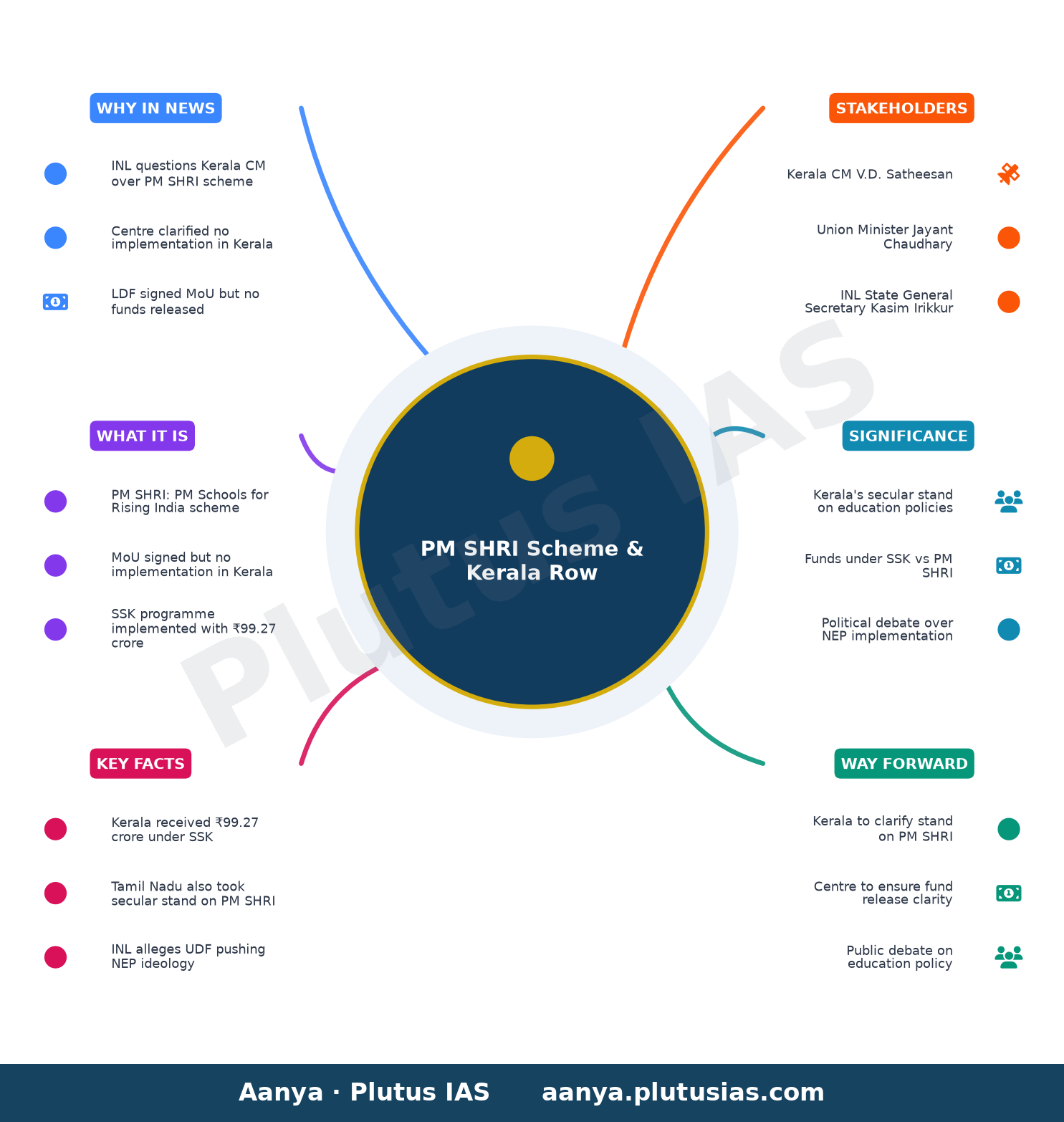
The Indian National League (INL) has raised concerns over Kerala Chief Minister V.D. Satheesan’s stance on the PM SHRI (Pradhan Mantri Schools for Rising India) scheme, questioning his claim that the state was obligated to implement it due to a previous memorandum of understanding (MoU) signed by the Left Democratic Front (LDF) government. The Centre, through Union Minister of State for Education Jayant Chaudhary, clarified in Parliament that the scheme had not been implemented in Kerala, and the state had only signed an MoU. The INL alleged that the Chief Minister’s repeated assertions contradicted the Centre’s clarification, as no government schools in Kerala had been included under the scheme, with only the Samagra Shiksha Kerala (SSK) programme receiving ₹99.27 crore in funds. The INL further accused the UDF government of attempting to implement the National Education Policy, which it claimed reflected the ideological vision of the RSS, raising questions about the state’s compliance with central schemes.
This issue holds relevance for banking, SSC, and RBI Grade B exam aspirants as it highlights the interplay between state and central governments in policy implementation, a key topic in polity and governance. Questions in these exams often test candidates’ understanding of federalism, inter-state relations, and the role of MoUs in policy execution. Additionally, the debate over the PM SHRI scheme underscores the importance of constitutional provisions related to education and the Centre’s discretion in fund allocation, which are frequently examined in competitive exams. Aspirants should focus on the legal and administrative nuances of such schemes to answer questions on governance and policy-making effectively.
Source: The Hindu
Generated by AanyaAi for educational purpose.
