
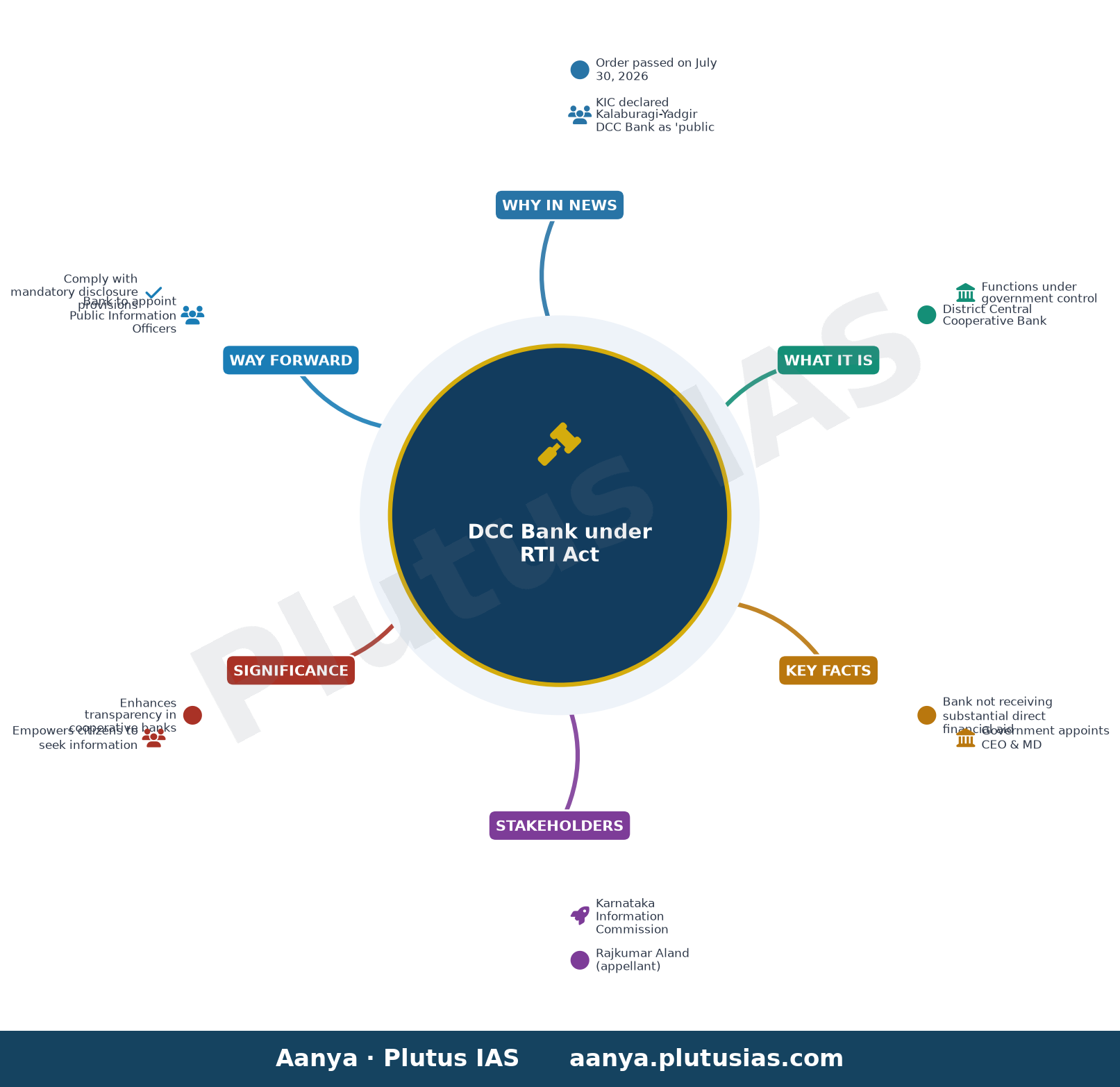
✎ Karnataka Information Commission brings Kalaburagi-Yadgir DCC Bank under RTI Act, ensuring transparency despite limited direct financial aid.
Relevance for Banking, SSC & RBI Grade B exams: Polity
The Karnataka Information Commission’s recent ruling declaring the Kalaburagi-Yadgir District Central Cooperative (DCC) Bank a “public authority” under the Right to Information (RTI) Act, 2005, carries significant implications for governance, transparency, and accountability in cooperative banking. The Commission’s decision hinges on the bank’s substantial government control, despite limited direct financial aid, as evidenced by the state’s share capital investment, appointment of key executives, and regulatory oversight through bodies like NABARD and the Apex Bank. This ruling aligns with the broader objective of the RTI Act to ensure transparency in institutions that, though not directly funded by the government, operate under its significant influence. For banking aspirants, particularly those preparing for exams like SBI PO, RBI Grade B, or SSC CGL, this case underscores the importance of understanding the RTI Act’s application beyond traditional government bodies, including cooperative institutions that play a pivotal role in rural and agricultural finance.
The directive issued by the Commission for the DCC Bank to appoint Public Information Officers and comply with proactive disclosure norms highlights the growing scrutiny over cooperative banks’ operations, which are often critical to financial inclusion in rural areas. For SSC aspirants, this case serves as a practical example of how constitutional and statutory provisions like the RTI Act intersect with cooperative governance, a topic frequently tested in exams. Similarly, for RBI Grade B candidates, the ruling reflects the regulator’s emphasis on transparency and accountability in cooperative banks, which are integral to the financial ecosystem. The Commission’s proactive stance—imposing penalties and compensations for non-compliance—further reinforces the need for aspirants to grasp the enforcement mechanisms of the RTI Act, a recurring theme in both banking and civil service examinations.
Source: The Hindu
Generated by AanyaAi for educational purpose.
