
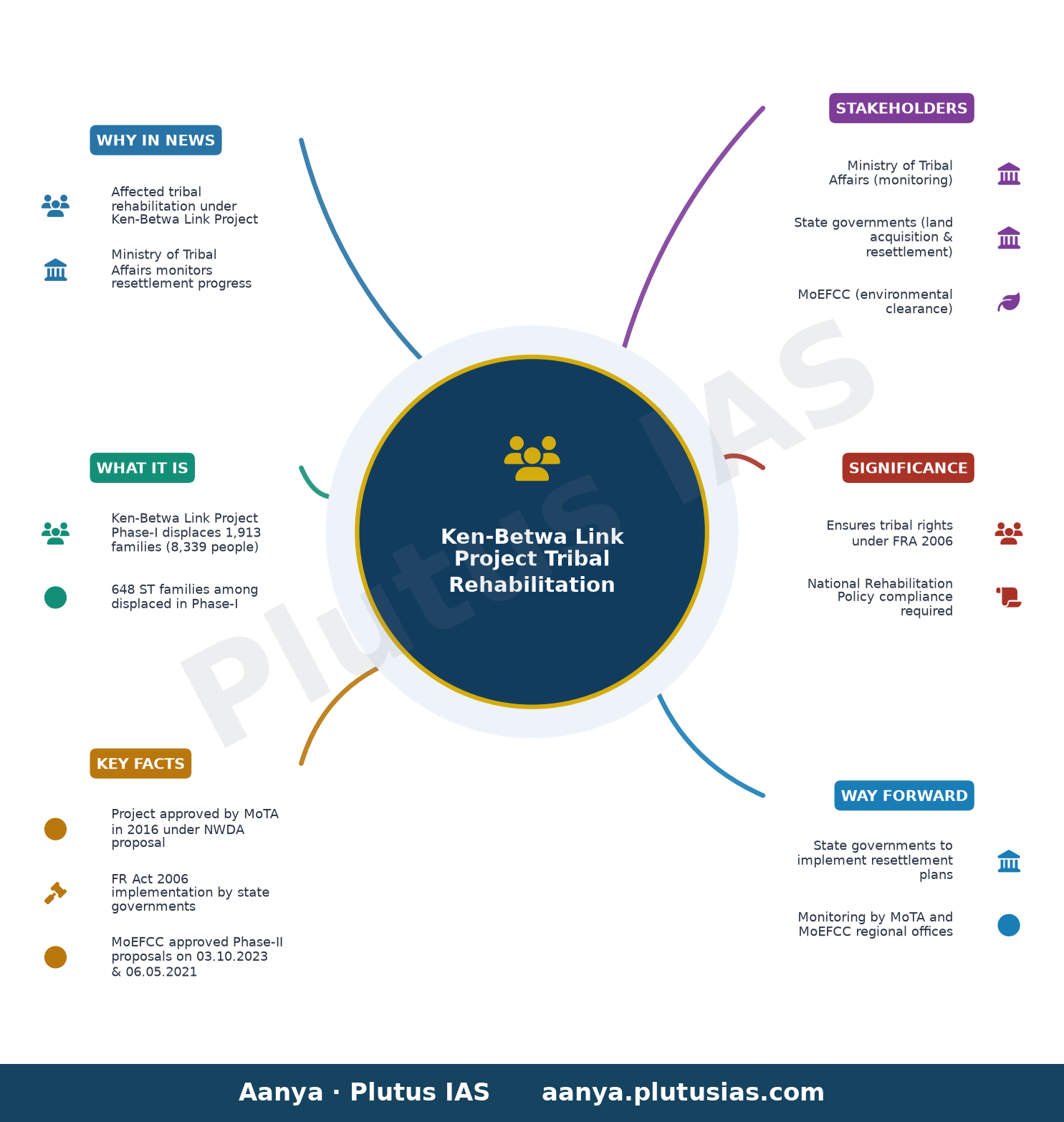
✎ Ken-Betwa Link Project requires strict tribal resettlement compliance under FRA 2006 and National Rehabilitation Policy.
Relevance for Banking, SSC & RBI Grade B exams: Polity & Governance
The Ken-Betwa Link Project (KBLP), a river interlinking initiative under the National Perspective Plan, aims to address water scarcity in drought-prone regions of Madhya Pradesh and Uttar Pradesh. As per a PIB release dated August 6, 2026, the Tribal Affairs Ministry has clarified that while land acquisition and rehabilitation activities are being managed by state governments, the Ministry monitors the implementation of resettlement plans for Scheduled Tribe (ST) project-affected families (PAFs) through its representation in the project’s operational and monitoring committees. Notably, out of 1,913 PAFs displaced in Phase-I (affecting 8,339 people), 648 belong to ST communities, underscoring the project’s socio-legal implications under the Forest Rights Act (FRA), 2006. The Ministry has not received complaints regarding non-disbursal of compensation but has noted issues with timely benefit delivery, prompting investigations by the Madhya Pradesh government under the FRA’s purview.
For banking and SSC aspirants, the KBLP highlights critical governance paradigms—land acquisition laws, tribal rights, and inter-state river disputes—which are frequently tested in exams like IBPS PO, RBI Grade B, and SSC CGL. The project’s alignment with the FRA, 2006, and the National Rehabilitation and Resettlement Policy, 2007, reflects the intersection of constitutional provisions (Article 21, Directive Principles) and administrative challenges, a recurring theme in polity sections. RBI Grade B candidates should note how such infrastructure projects impact fiscal policies, rural livelihoods, and environmental compliance, while SSC aspirants may encounter questions on tribal welfare schemes or parliamentary discussions on interlinking projects. The absence of centralized data on FRA violations further emphasizes the need for aspirants to understand federalism and decentralized governance structures.
Source: PIB (Press Information Bureau)
Generated by AanyaAi for educational purpose.
