
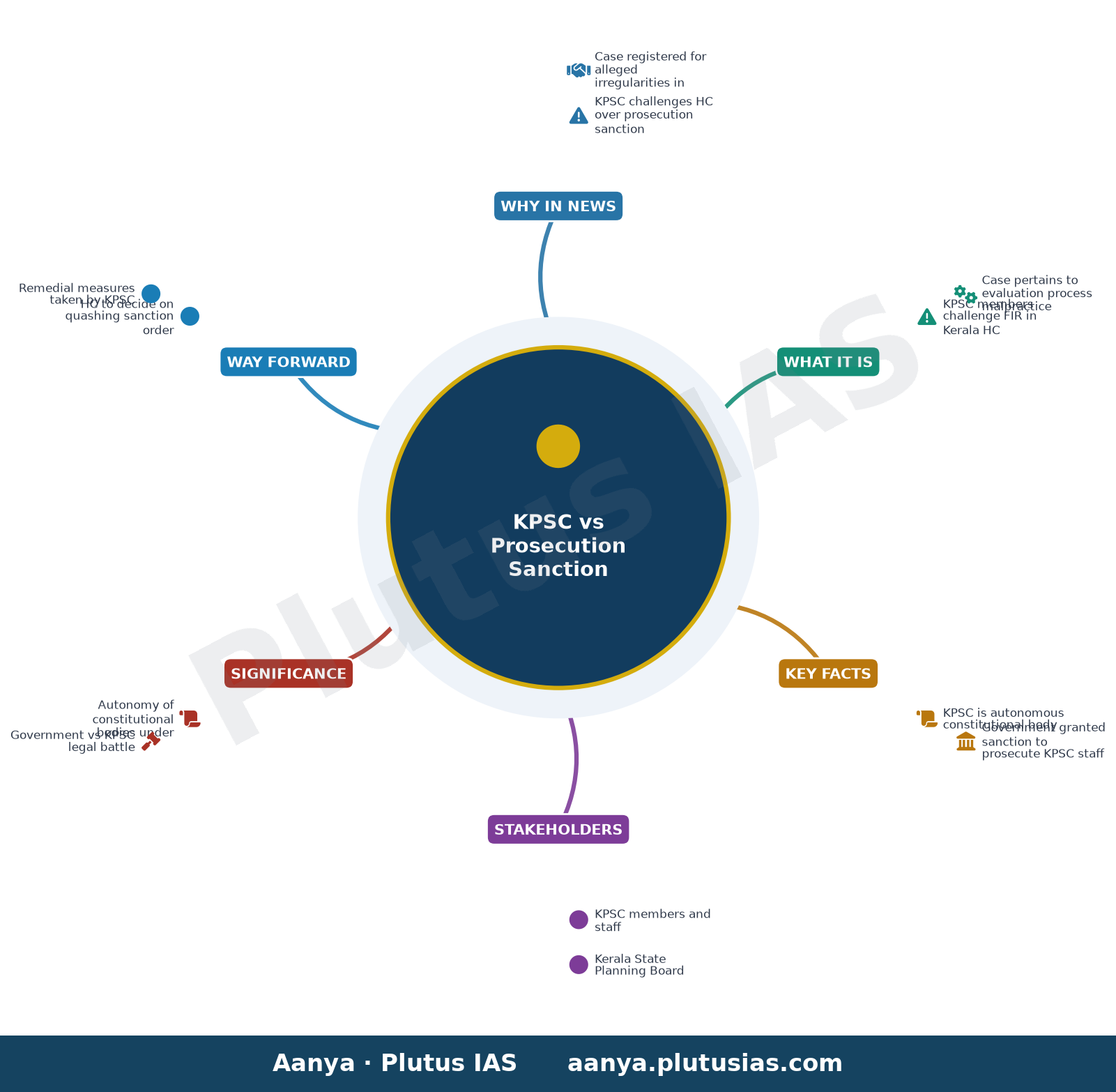
✎ KPSC challenges prosecution sanction, highlighting autonomy of constitutional bodies and legal scrutiny over appointment irregularities.
Relevance for Banking, SSC & RBI Grade B exams: Polity
The Kerala Public Services Commission (KPSC) has approached the Kerala High Court, challenging a prosecution sanction order and an FIR registered against its members and staff over alleged irregularities in the appointment of the Chief (Industry and Infrastructure Division) of the Kerala State Planning Board. The case pertains to malpractices in the evaluation process for the appointment, with the KPSC arguing that the state government’s sanction to prosecute its employees was unjustified, as no specific individuals were named in the FIR. The KPSC, an autonomous constitutional body, contended that its members could only be removed by the President of India, asserting that it operates independently of state control. The commission also claimed that it had rectified errors in the evaluation process, including misallocation of economics questions to evaluators, which led to non-assessment.
This issue holds relevance for Banking, SSC, and RBI Grade B exam aspirants as it highlights constitutional provisions related to autonomous bodies, the role of the judiciary in administrative disputes, and the legal framework governing public service commissions. Questions on the autonomy of constitutional bodies, the process of appointments, and judicial review of administrative actions are common in these examinations. Additionally, the case underscores the importance of transparency and accountability in public appointments, a topic often tested in the General Awareness sections of these exams. Understanding such constitutional and administrative nuances can aid aspirants in tackling polity-based questions effectively.
Source: The Hindu
Generated by AanyaAi for educational purpose.

1 comment on “KPSC Challenges Prosecution Sanction in Kerala High Court Over Irregularities in State Planning Board Appointment”