
✎ NAMASTE scheme strengthens safety, dignity, and livelihood of sanitation workers through verification, PPE, insurance, and mechanization.
Relevance for Banking, SSC & RBI Grade B exams: Polity & Governance
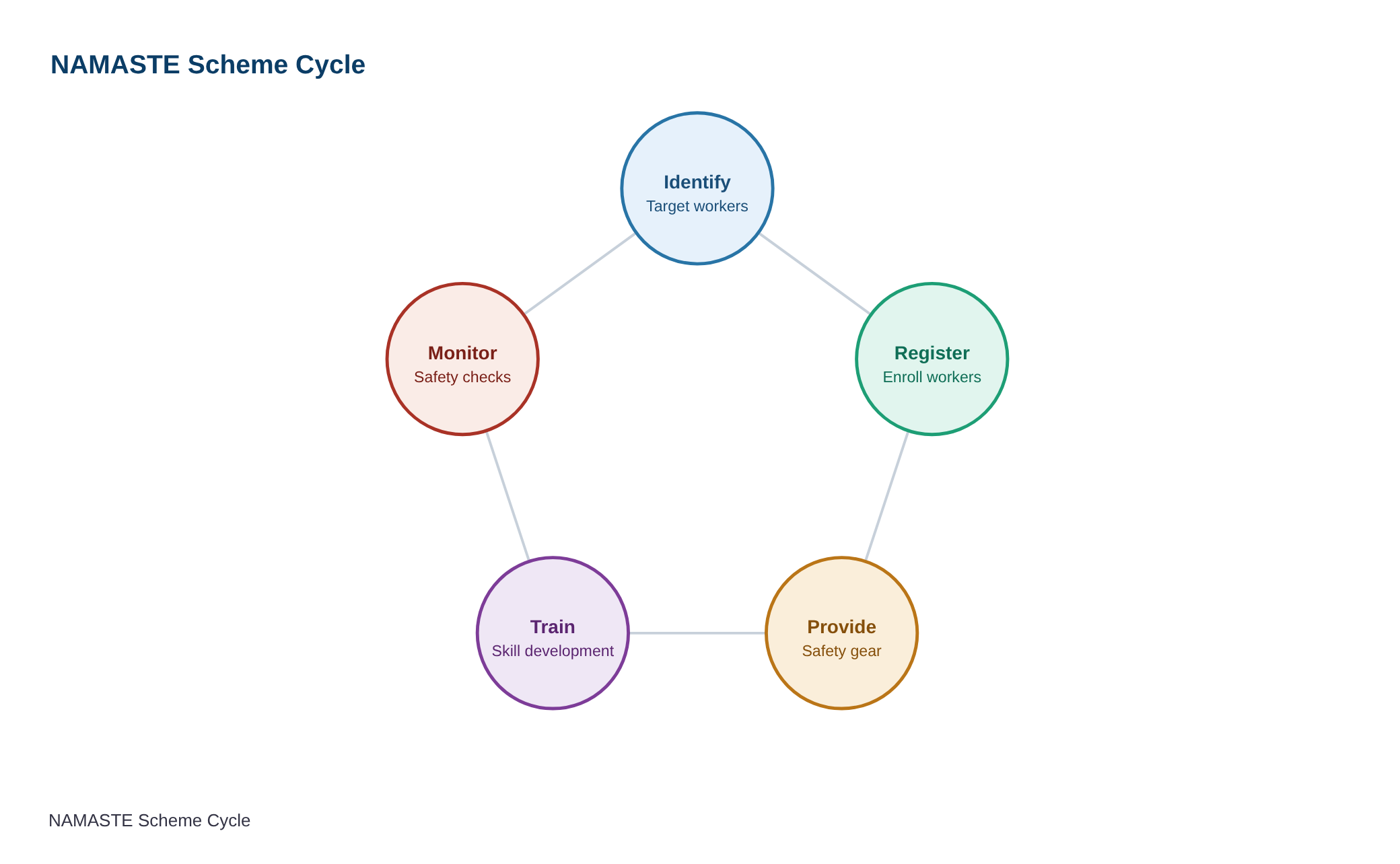
The *NAMASTE* (National Action for Mechanised Sanitation Ecosystem) scheme, launched under the Ministry of Social Justice and Empowerment, aims to ensure the safety, dignity, and livelihood support of sanitation workers, including sewer and septic tank cleaners and waste pickers. As of 22 September 2026, the scheme has verified 90,186 sewer and septic tank workers across all 36 states and union territories, with 86,468 men, 3,713 women, and 5 transgender individuals identified. Additionally, 2,51,756 waste pickers have been profiled in 34 states and UTs, including 1,35,233 men, 1,16,498 women, and 25 transgender persons. The scheme has distributed over 87,008 PPE kits and 753 emergency response sanitation units, while also providing health insurance (27,034 e-KYC processes completed) and vocational training (5,449 sessions) to sewer workers. For waste pickers, 7,526 health insurance enrollments and capacity-building initiatives are underway, supported by 17 training providers and 33 resource organizations. The scheme’s interventions, including capital subsidies for mechanization (₹34.16 crore disbursed to 983 beneficiaries), underscore its focus on sustainable livelihoods, skill development, and safety.
For aspirants preparing for Bank PO, IBPS, SBI, RBI Grade B, and SSC exams, *NAMASTE* holds significance as a flagship government initiative addressing social justice and labor welfare. The scheme aligns with the *Sustainable Development Goals (SDGs)*, particularly SDG 8 (Decent Work and Economic Growth) and SDG 10 (Reduced Inequalities), making it relevant for questions on poverty alleviation, inclusive growth, and policy frameworks. Banking exams may test awareness of schemes promoting financial inclusion (e.g., health insurance via e-KYC) and skill development, while SSC and RBI Grade B aspirants could encounter questions on the scheme’s implementation, funding mechanisms (e.g., NSSFDC’s role), or its impact on urban sanitation infrastructure. The scheme also reflects the government’s commitment to formalizing informal labor sectors, a key theme in governance and economic policy discussions.
Source: PIB (Press Information Bureau)
Generated by AanyaAi for educational purpose.
