
Relevance for Banking, SSC & RBI Grade B exams: Polity & Governance
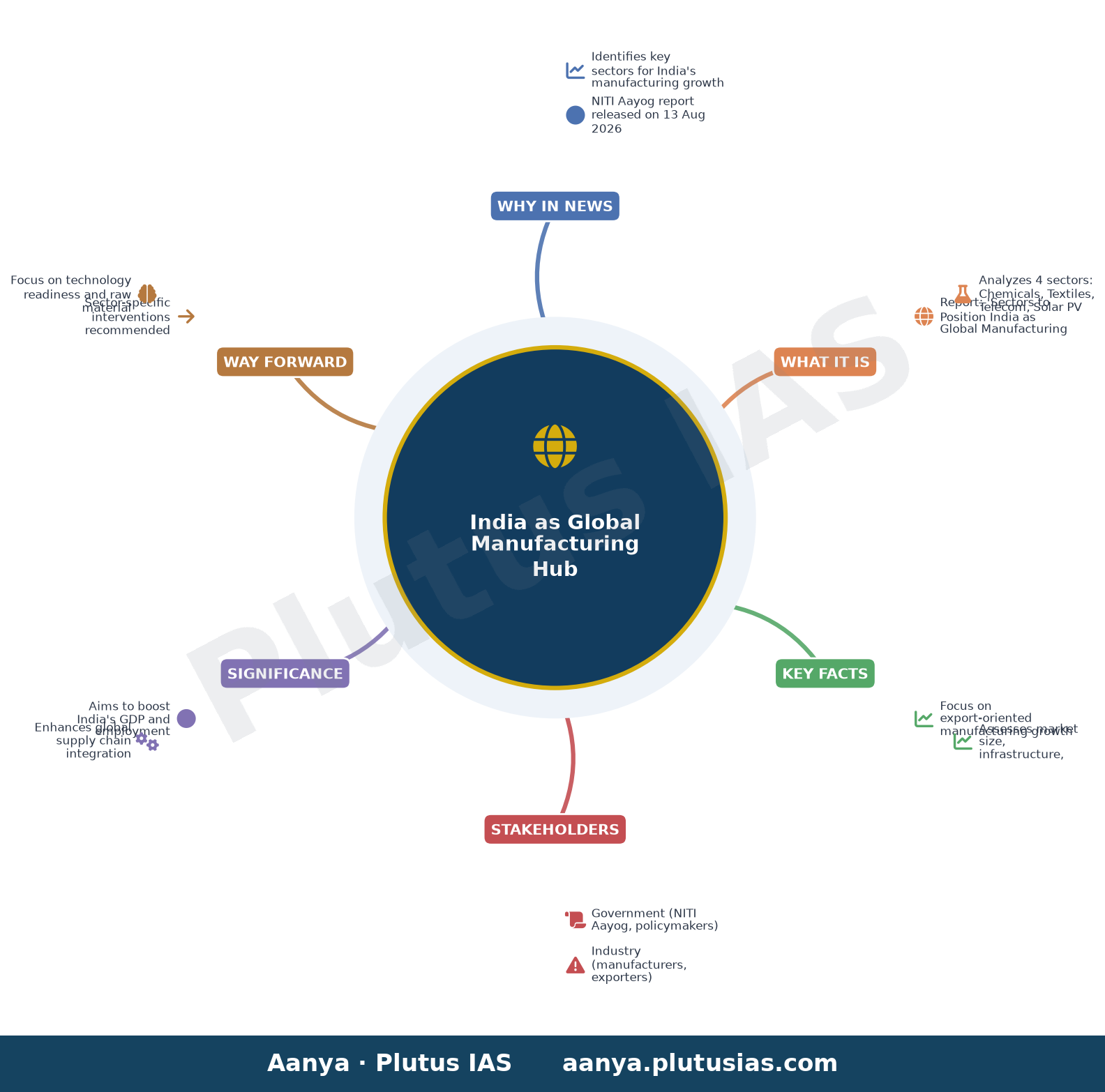
The NITI Aayog’s report titled *“Key Sectors to Position India as a Global Manufacturing Hub”* identifies four high-potential manufacturing sectors—chemicals, textiles, telecom & networking equipment, and solar photovoltaics (PV)—to accelerate India’s ambition of becoming a global manufacturing powerhouse. The report, structured in four phases, evaluates these sectors based on market potential, infrastructure readiness, policy support, and global competitiveness, while drawing lessons from leading manufacturing nations. For banking and SSC aspirants, this report is crucial as it highlights India’s export-oriented growth strategy, which directly impacts trade policies, foreign investments, and economic reforms—key topics in exams like IBPS, SBI, and SSC CGL. The emphasis on sectors like chemicals and textiles, which contribute significantly to GDP and employment, also ties into government schemes like *Make in India* and *PLI*, often tested in descriptive papers or group discussions.
For RBI Grade B aspirants, the report underscores the role of manufacturing in achieving self-reliance (*Atmanirbhar Bharat*) and its macroeconomic implications, such as reducing import dependence, boosting exports, and enhancing supply chain resilience. The focus on telecom and solar PV sectors aligns with India’s push for digital transformation and renewable energy adoption, which are critical for sustainable growth and climate commitments—frequent themes in RBI’s economic and monetary policy analyses. Additionally, the report’s discussion on policy interventions, infrastructure gaps, and global best practices provides insights into governance challenges, a recurring subject in RBI Grade B’s *Economic and Social Issues* paper. Aspirants should link these sectors to broader economic policies, fiscal measures, and international trade dynamics to strengthen their answers in both prelims and mains exams.
Source: PIB (Press Information Bureau)
Generated by AanyaAi for educational purpose.
