✎ PLI schemes boost domestic pharma & med-tech manufacturing, reducing imports and enhancing self-reliance.
Relevance for Banking, SSC & RBI Grade B exams: Polity & Governance
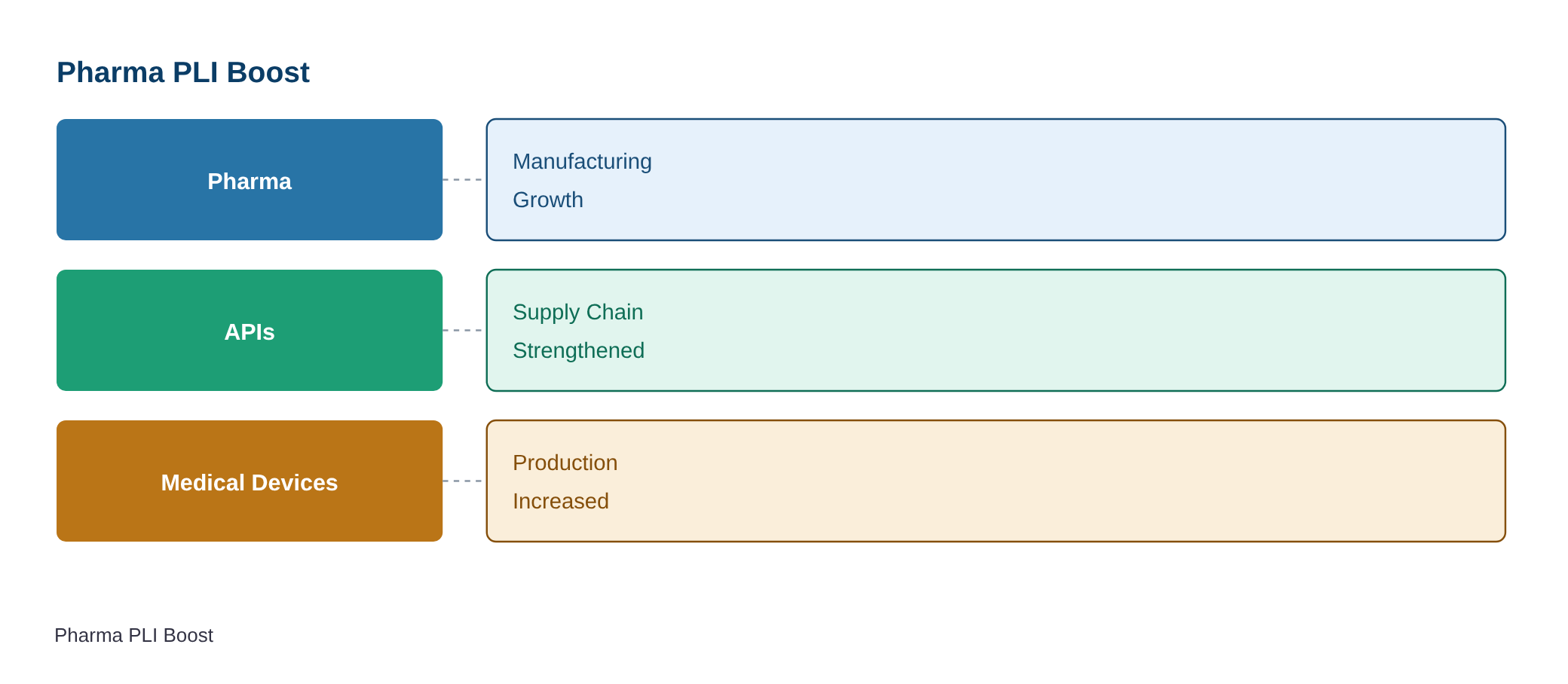
The Government of India’s Production-Linked Incentive (PLI) schemes have significantly strengthened India’s pharmaceutical, active pharmaceutical ingredients (APIs), and medical device manufacturing sectors by boosting domestic production, reducing import dependence, and encouraging technology adoption. These schemes align with the ‘Make in India’ and ‘Atmanirbhar Bharat’ initiatives, fostering self-reliance in critical sectors. Under the PLI scheme for bulk drugs (APIs/KSMs/DIs), 48 projects worth ₹5,210.74 crore have been approved, enabling domestic production of essential drugs like Penicillin-G and Clavulanic Acid, previously reliant on imports. Similarly, the PLI scheme for pharmaceuticals has attracted ₹46,744 crore in investments, supporting high-value drug manufacturing, while the medical devices PLI scheme has facilitated the production of advanced equipment such as MRI machines and CT scanners, reducing reliance on foreign imports.
For banking, SSC, and RBI Grade B aspirants, understanding these schemes is crucial as they reflect government policies aimed at economic growth, self-sufficiency, and sectoral development. These initiatives also highlight the role of financial incentives in driving industrial expansion, which is relevant for questions on fiscal policies, GDP growth, and employment generation in competitive exams. Additionally, the schemes underscore India’s strategic focus on high-value manufacturing, making them a key topic for current affairs sections in exams like IBPS, SBI PO, and SSC CGL.
Source: PIB (Press Information Bureau)
Generated by AanyaAi for educational purpose.
