
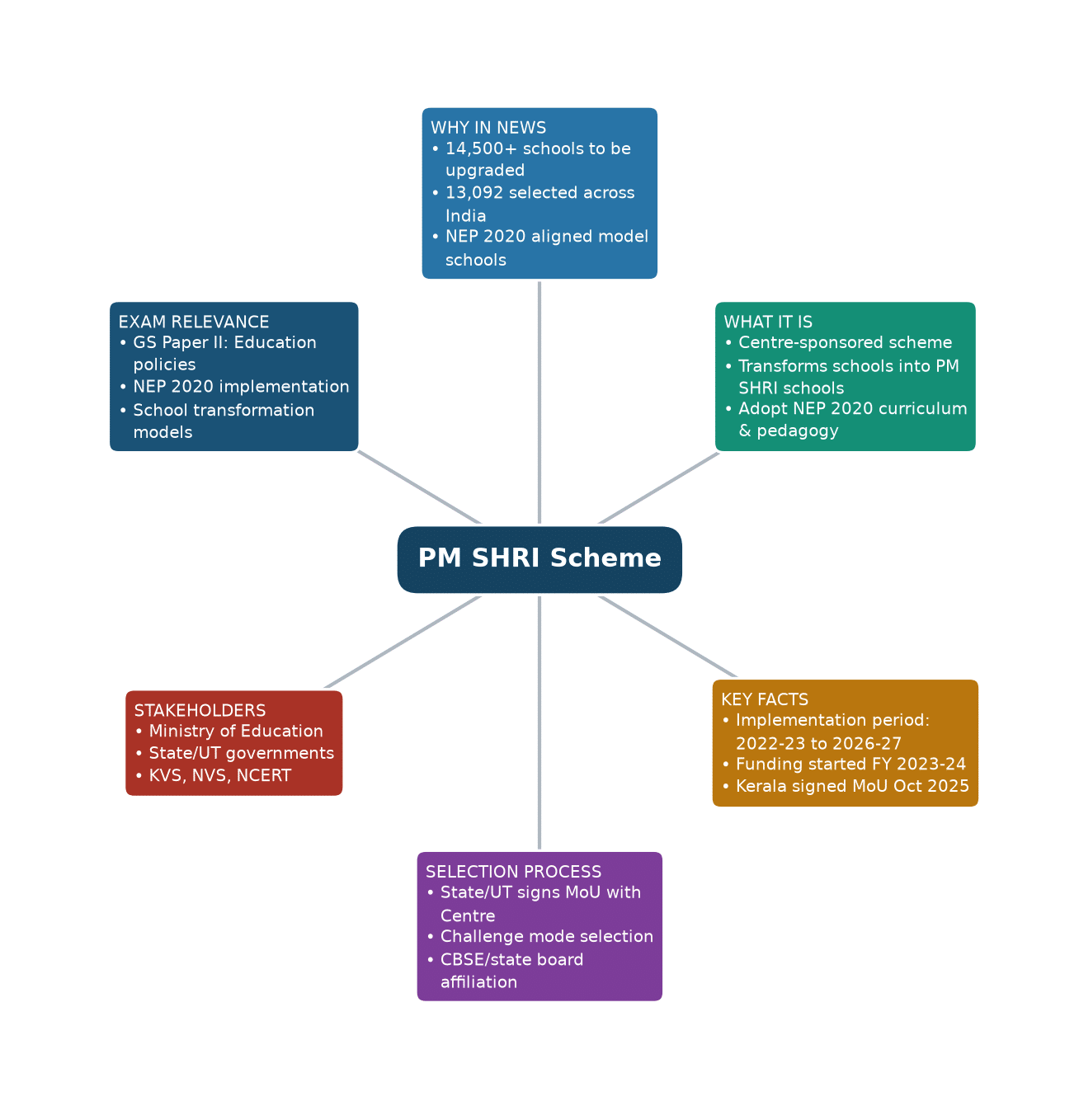
Map & concept mind-map: PM SHRI Scheme: 13,092 Schools Selected
Relevance for Banking, SSC & RBI Grade B exams: Polity & Governance
The *Pradhan Mantri Schools for Rising India (PM SHRI)* scheme, a centrally sponsored initiative, aims to strengthen over 14,500 schools across India by transforming them into model institutions aligned with the *National Education Policy (NEP) 2020*. As of now, 13,092 schools—including those under the Kendriya Vidyalaya Sangathan (KVS), Navodaya Vidyalaya Samiti (NVS), and NCERT—have been selected as PM SHRI schools, serving as benchmarks for quality education and inclusive learning. These schools prioritize equitable access, multilingual support, and student-centric pedagogy, fostering a nurturing environment where children from diverse backgrounds can thrive. The scheme’s implementation spans 2022-23 to 2026-27, with funding disbursed annually, and states must sign MoUs to avail its benefits, ensuring accountability and transparency through a competitive *Challenge Mode* selection process.
For aspirants of *Bank PO, IBPS, SBI, RBI Grade B, and SSC exams*, PM SHRI holds significance as a flagship governance initiative reflecting India’s policy priorities in education and social equity. The scheme’s focus on *NEP 2020*—which emphasizes holistic development, 21st-century skills, and digital integration—aligns with broader themes in public administration and economic growth often tested in these exams. Additionally, the financial outlay, MoU-based implementation, and multi-stakeholder coordination (involving states, KVS, NVS, and NCERT) mirror real-world governance challenges, making it a potential case study for *RBI Grade B’s Economic & Social Issues* or *SSC CGL’s Polity & Governance* sections. Questions may also probe the scheme’s impact on reducing educational disparities or its role in achieving *Sustainable Development Goal 4 (Quality Education)*, linking it to socio-economic development—a recurring theme in competitive exams.
Source: PIB (Press Information Bureau)
Generated by AanyaAi for educational purpose.
