✎ RBI's Forward Looking Surveys offer critical macroeconomic insights for policy decisions.
Relevance for Banking, SSC & RBI Grade B exams: Economy/Governance
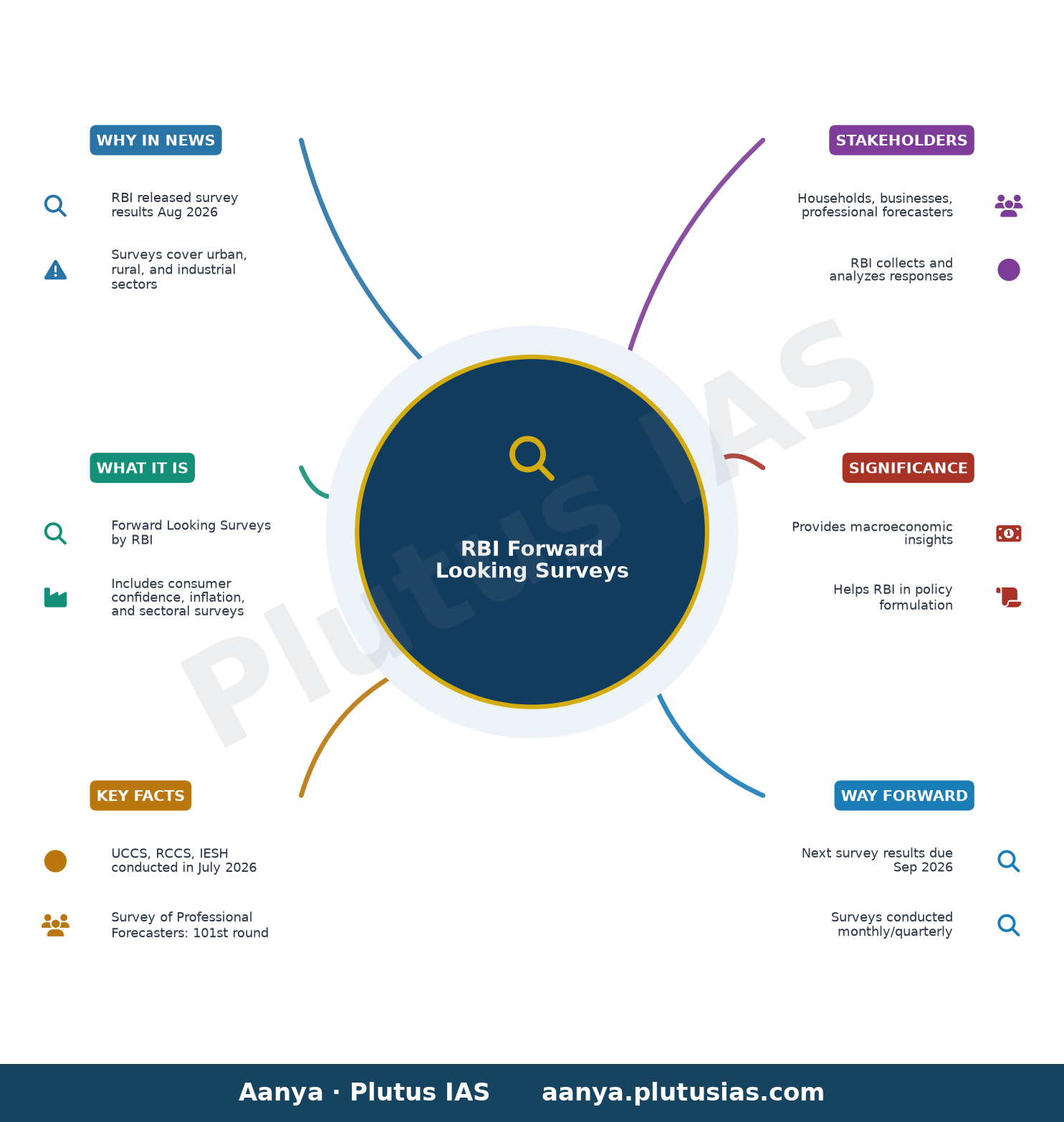
The Reserve Bank of India (RBI) recently released the results of several forward-looking surveys, including the Urban Consumer Confidence Survey (UCCS), Inflation Expectations Survey of Households (IESH), and Rural Consumer Confidence Survey (RCCS) for July 2026, along with the Survey of Professional Forecasters on Macroeconomic Indicators. Other key surveys covered include the Order Books, Inventories and Capacity Utilisation Survey for Q4:2025-26, the Industrial Outlook Survey for Q1:2026-27, the Bank Lending Survey for Q1:2026-27, and the Services and Infrastructure Outlook Survey for Q1:2026-27. These surveys gauge consumer sentiment, inflation expectations, and sectoral outlooks, providing critical insights into economic trends that influence monetary policy decisions. For aspirants preparing for exams like RBI Grade B and SSC, understanding these surveys is vital as they reflect macroeconomic conditions, which are often tested in the General Awareness sections.
The release of these survey results is particularly relevant for Banking and SSC examinations, as questions on RBI policies, inflation trends, and economic indicators frequently appear in their syllabi. The surveys help assess household and business expectations, which can impact interest rates, credit growth, and overall economic stability—key areas of focus in competitive exams. For instance, the Inflation Expectations Survey directly relates to RBI’s monetary policy stance, while the Industrial Outlook Survey provides insights into manufacturing sector performance. Aspirants should analyze such data to answer questions on economic policies, inflation control measures, and sectoral growth projections, making these surveys a crucial study topic for exam preparation.
Source: RBI
Generated by AanyaAi for educational purpose.
