
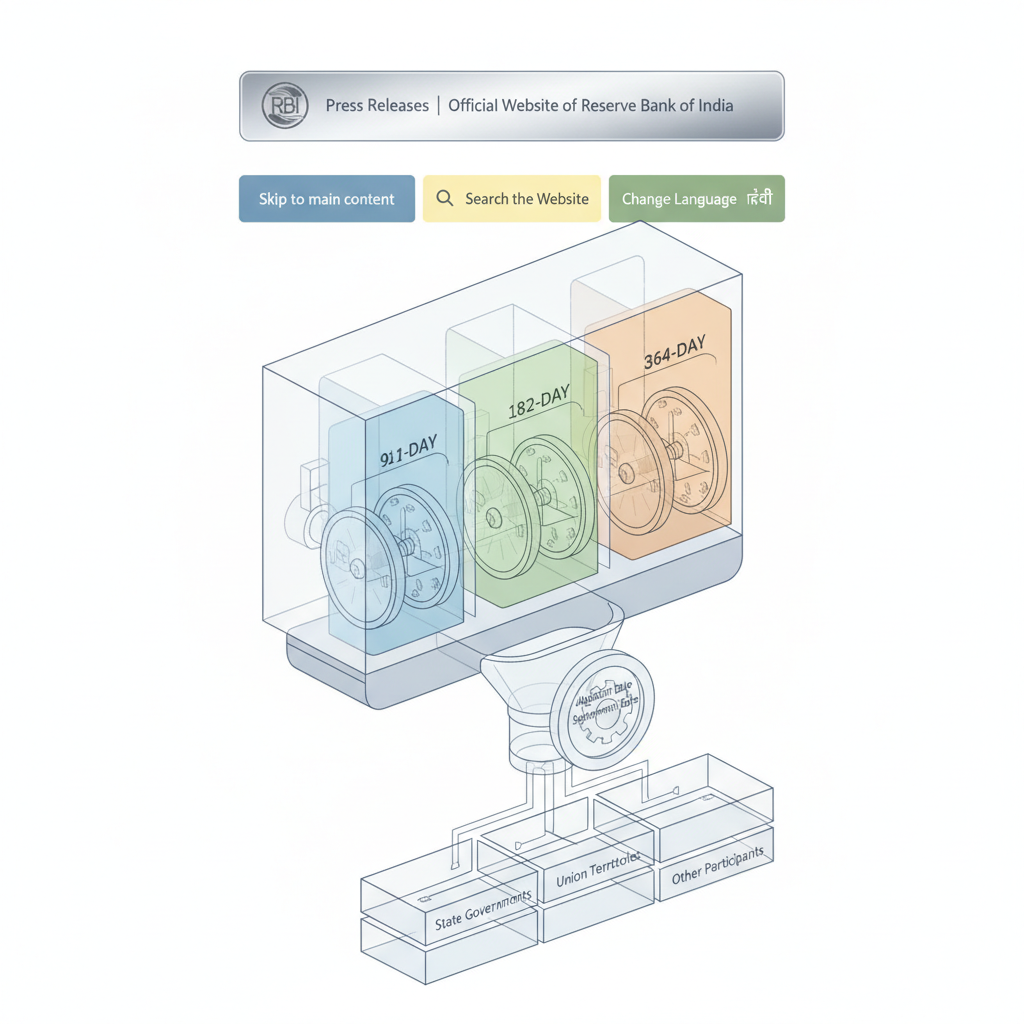
✎ Treasury Bills are short-term government securities auctioned by RBI to raise funds with maturities of 91, 182, or 364 days.
Relevance for Banking, SSC & RBI Grade B exams: Polity
The Reserve Bank of India (RBI) has announced the auction of 91-day, 182-day, and 364-day Treasury Bills (T-Bills) with a total notified amount of ₹24,000 crore, scheduled for September 9, 2026. The auction will follow a price-based multiple price method, where bids will be submitted electronically via the RBI’s Core Banking Solution (E-Kuber system) between 10:30 am and 11:30 am for competitive bids and until 11:00 am for non-competitive bids. Successful bidders must make payments by September 10, 2026. The auction also allows retail investors to participate on a non-competitive basis through the RBI Retail Direct portal, with a maximum allocation of 5% of the notified amount. This mechanism ensures liquidity management and government borrowing while offering secure investment avenues for individuals and institutions.
For banking and SSC aspirants, understanding T-Bill auctions is crucial as they reflect monetary policy tools used by the RBI to regulate liquidity and interest rates. Questions in exams like Bank PO, IBPS, SBI, RBI Grade B, and SSC often test knowledge of such instruments, their auction processes, and their role in public debt management. The RBI’s structured approach to T-Bill auctions—including competitive and non-competitive bidding, settlement timelines, and retail participation—highlights the importance of financial market operations in governance and economic policy, making it a key topic for competitive exam preparation.
Source: RBI
Generated by AanyaAi for educational purpose.
