
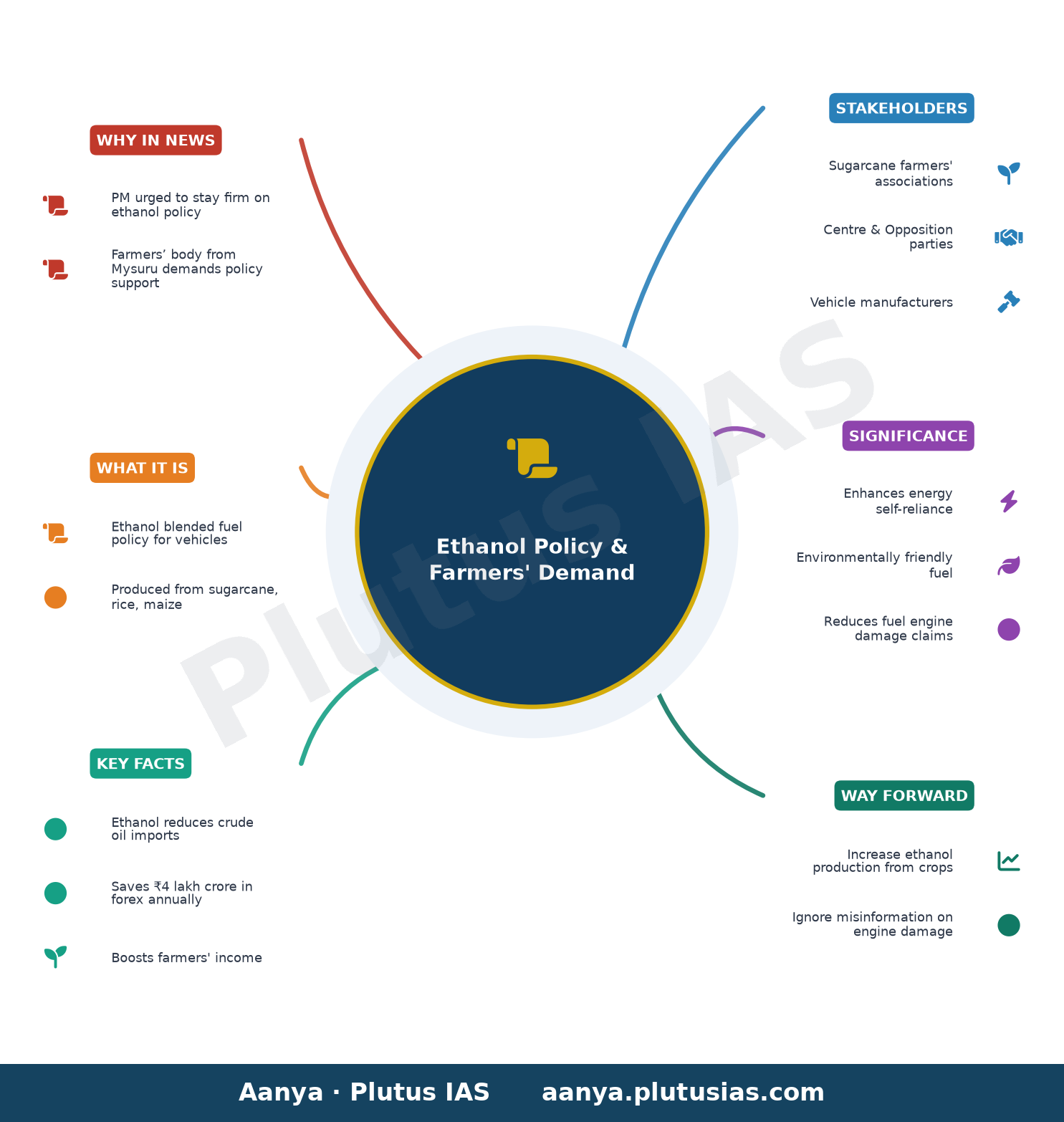
✎ Ethanol policy boosts farmers' income, reduces fuel imports, and ensures energy self-reliance.
Relevance for Banking, SSC & RBI Grade B exams: Polity & Governance
Sugarcane growers in Mysuru have urged Prime Minister Narendra Modi to maintain the Centre’s ethanol policy, emphasizing its role in boosting farmers’ income and reducing India’s crude oil imports. The Indian Sugarcane Farmers’ Association, led by Kurubur Shanthkumar, argued that ethanol production from sugarcane, rice, and maize would enhance economic self-reliance while countering misinformation about its impact on vehicle engines and fuel efficiency. The association claimed that increased ethanol usage could save nearly ₹4 lakh crore in foreign exchange by reducing crude oil imports, thereby strengthening the economy and enabling greater public investment.
This issue holds relevance for banking, SSC, and RBI Grade B aspirants as it intersects with economic policies, agricultural reforms, and energy security—key topics in competitive exams. Understanding the ethanol blending policy’s economic implications, such as its impact on forex reserves and farmers’ welfare, aligns with the syllabus on government schemes, budgetary allocations, and sustainable development. Additionally, the policy’s role in reducing import dependency and promoting alternative fuels reflects broader themes of self-reliance (*Atmanirbhar Bharat*) and environmental sustainability, which are frequently tested in exams like RBI Grade B and SSC CGL.
Source: The Hindu
Generated by AanyaAi for educational purpose.
