
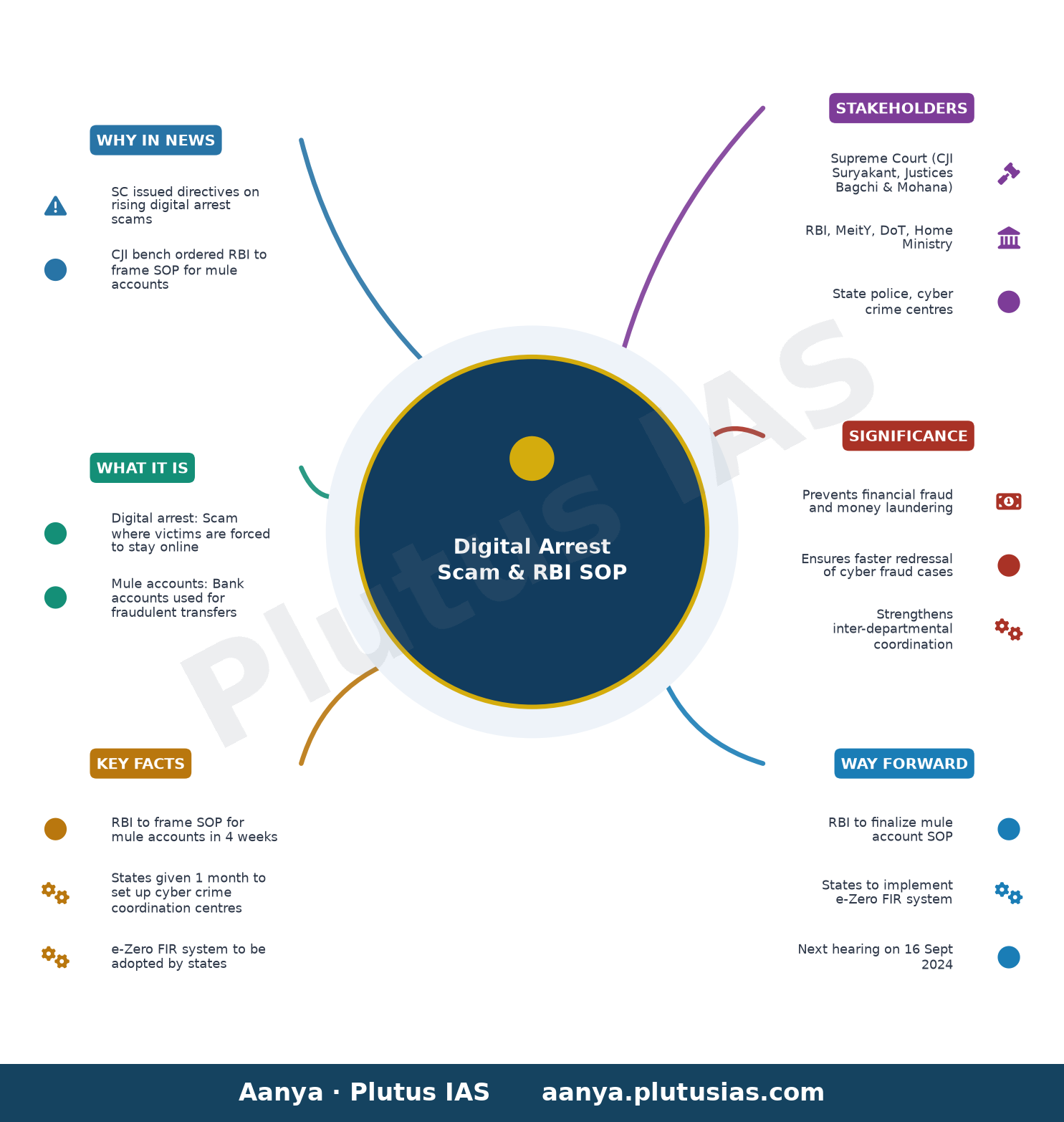
✎ Supreme Court directs RBI and states to curb digital arrest scams via SOPs, faster redressal, and inter-departmental coordination.
Relevance for Banking, SSC & RBI Grade B exams: Polity
The Supreme Court has directed the Reserve Bank of India (RBI) to formulate a Standard Operating Procedure (SOP) within four weeks to address the misuse of *mule accounts*—bank accounts exploited by fraudsters for money laundering and illegal fund transfers, particularly in digital arrest scams. The apex court also emphasized the urgent implementation of cyber fraud prevention mechanisms across states, urging the adoption of the *Indian Cyber Crime Coordination Centre (I4C)*’s 2 January SOP for grievance redressal and fund recovery. This directive is crucial for banking aspirants, as it underscores the RBI’s regulatory role in combating financial fraud, a key concern for exams like RBI Grade B and SBI PO, where questions on banking regulations and cybersecurity are common. For SSC aspirants, the focus on inter-departmental coordination (I4C, MeitY, DoT) highlights the government’s multi-pronged approach to cybercrime, relevant for general awareness sections.
The court’s order also mandates states to establish *State Cyber Crime Coordination Centres* within a month and adopt *e-Zero FIR* systems for faster reporting of cyber frauds. Additionally, it proposes time-based restrictions on telecom services for suspicious audio/video calls—a measure that aligns with the banking sector’s push for stricter KYC norms and transaction monitoring. For banking exams, this reflects the evolving challenges in fraud detection, while for SSC, it ties into broader governance and digital infrastructure themes. The next hearing on 16 September will assess state-wise progress, making this a dynamic topic for current affairs preparation.
Source: bhaskar.com
Generated by AanyaAi for educational purpose.
