
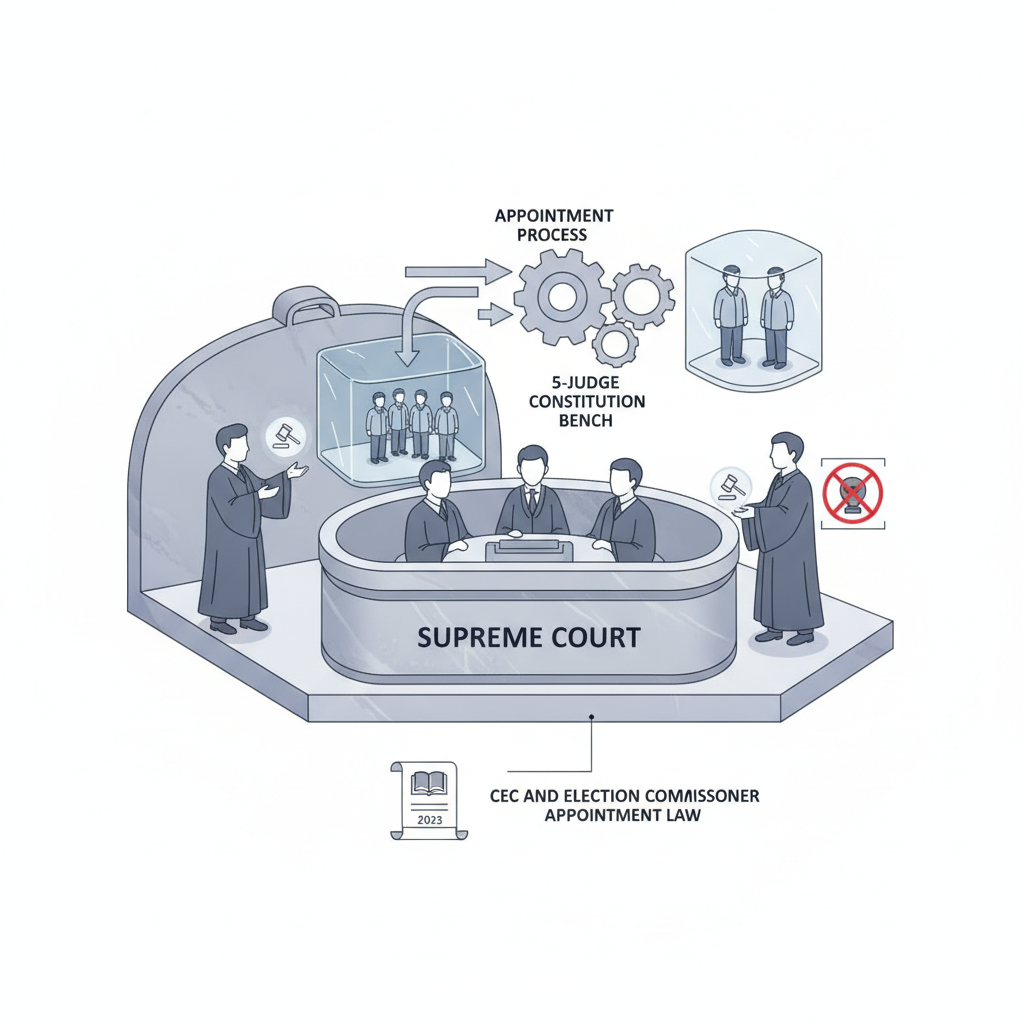
✎ 2023 Act replaced CJI-led committee with PM-centric selection, SC split on its validity.
Relevance for Banking, SSC & RBI Grade B exams: Polity
The Supreme Court’s recent hearing on the appointment of Chief Election Commissioner (CEC) and Election Commissioners (EC) has highlighted a division among judges regarding the validity of the *Chief Election Commissioner and Other Election Commissioners (Appointment, Conditions of Service and Term of Office) Act, 2023*. While Justice Deepankar Datta opposed referring the case to a larger five-judge bench, Justice Satish Chandra Sharma favored it, with both agreeing to place the matter before Chief Justice of India (CJI) D.Y. Chandrachud for a final decision. The dispute stems from the 2023 law, which replaced the Supreme Court-mandated selection committee (comprising the PM, Leader of Opposition, and CJI) with a new committee that excludes the CJI and includes a minister nominated by the PM. Petitioners, including the ADR, argue that this undermines the EC’s independence, a concern echoed by Justice Datta, who stressed that the EC must not only be independent but also appear so to the public. The case assumes significance for banking and SSC aspirants, as questions of constitutional validity, separation of powers, and institutional independence often feature in exams like RBI Grade B and UPSC, testing candidates’ understanding of governance and judicial oversight.
The hearing also brought to light contrasting judicial perspectives on legislative intent versus judicial intervention. Justice Sharma justified referring the case to a larger bench by citing Parliament’s role in enacting the 2023 law, while Justice Datta raised concerns about executive dominance in appointments, questioning whether a nominated minister could act independently. The Solicitor General’s argument that the government’s intent cannot be presumed malevolent was countered by the bench’s focus on procedural fairness. For banking and SSC exams, this case underscores the interplay between constitutional amendments, judicial review, and democratic principles—key topics in polity sections. Aspirants should note how such rulings reflect evolving interpretations of Articles 324 and the basic structure doctrine, which are frequently tested in competitive exams.
Source: bhaskar.com
Generated by AanyaAi for educational purpose.

1 comment on “Supreme Court Divided Over CEC Appointment Law: 5-Judge Bench Proposal Rejected”