✎ Tamil Nadu Budget 2026 focuses on AI-driven urban planning and affordable housing through PPP model.
Relevance for Banking, SSC & RBI Grade B exams: Polity & Governance
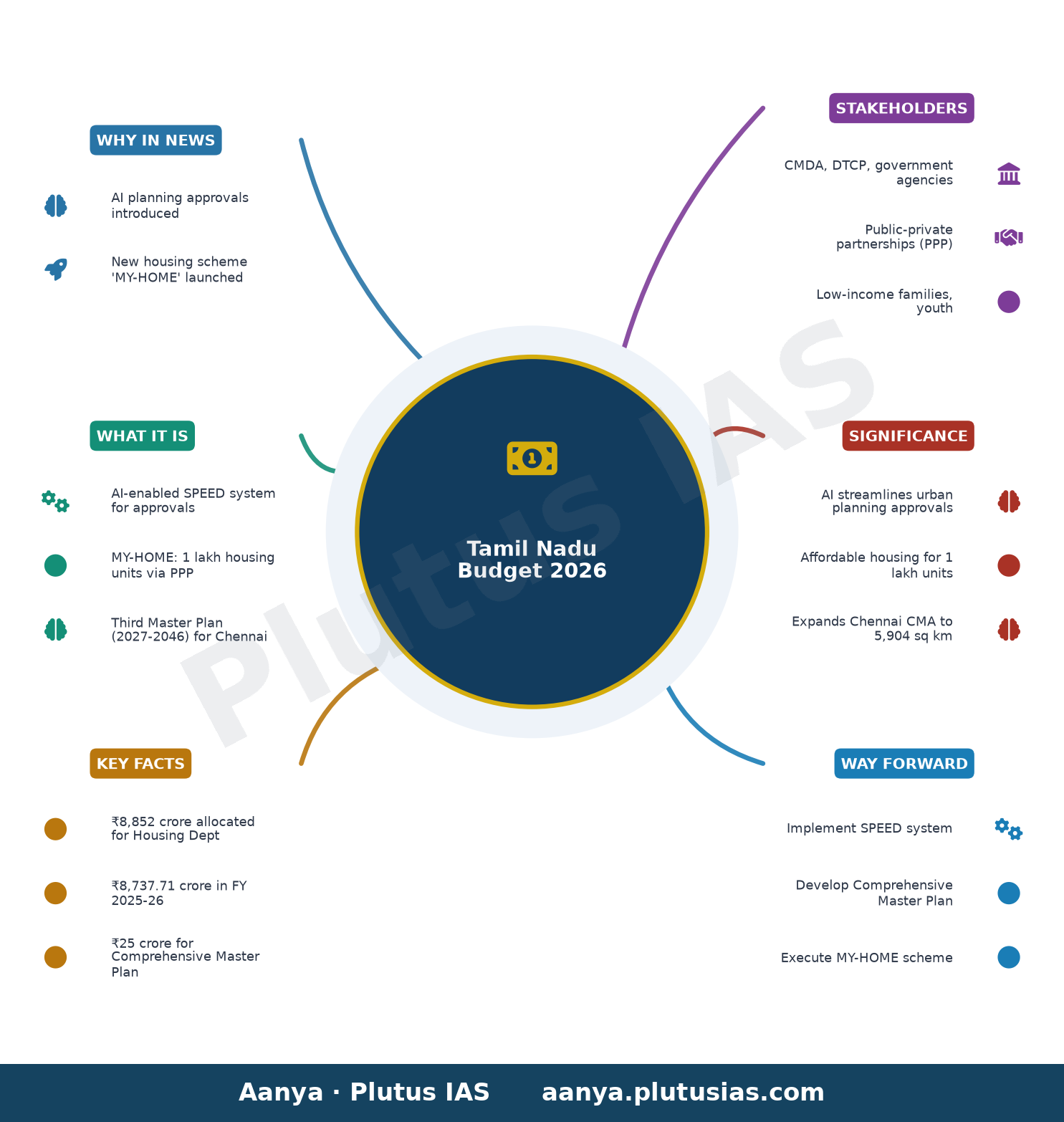
The Tamil Nadu Budget 2026-27, presented by Finance Minister N. Marie Wilson, introduces significant initiatives in urban governance and housing, which hold relevance for banking, SSC, and RBI Grade B exam aspirants. The budget allocates ₹8,852 crore for the Housing and Urban Development Department, a notable increase from previous years, reflecting the state’s focus on sustainable urban development. The introduction of the AI-enabled **Single Platform for Efficient Expedited Development (SPEED)** to streamline planning approvals across multiple agencies like the CMDA and DTCP highlights the government’s emphasis on digital governance and transparency. Such technological integration in public administration is a key topic in governance sections of competitive exams, as it underscores the role of AI in improving efficiency and reducing bureaucratic delays. Additionally, the allocation of ₹40 crore for this initiative and ₹25 crore for the Third Master Plan (2027-2046) demonstrates the state’s commitment to long-term urban planning, a subject often tested in the **Polity & Governance** segment of exams like the RBI Grade B and SSC CGL.
The **Metropolitan Youth and Family Housing Scheme (MY-HOME)**, aimed at developing one lakh housing units over seven years through a public-private partnership model with an estimated investment of ₹15,000 crore, is another critical aspect of the budget. The scheme’s focus on affordable housing for low-income families and youth, supported by ₹3,500 crore in Viability Gap Funding, aligns with national priorities such as the Pradhan Mantri Awas Yojana (PMAY). For banking aspirants, this initiative reflects the government’s push for inclusive growth and financial inclusion, a topic frequently examined in **Economic & Social Development** sections. The **Digital Rental Voucher system** under MY-HOME further emphasizes the role of technology in social welfare schemes, a trend increasingly relevant in modern governance. Aspirants should note how such schemes integrate fiscal policy, public-private partnerships, and digital innovation, which are common themes in RBI Grade B and SSC exams, particularly in sections covering **Government Schemes, Urban Development, and Digital Governance**.
Source: The Hindu
Generated by AanyaAi for educational purpose.
