✎ Tamil Nadu Budget 2026 must balance fiscal consolidation with fulfilling TVK's poll promises amid high public expectations.
Relevance for Banking, SSC & RBI Grade B exams: Economy
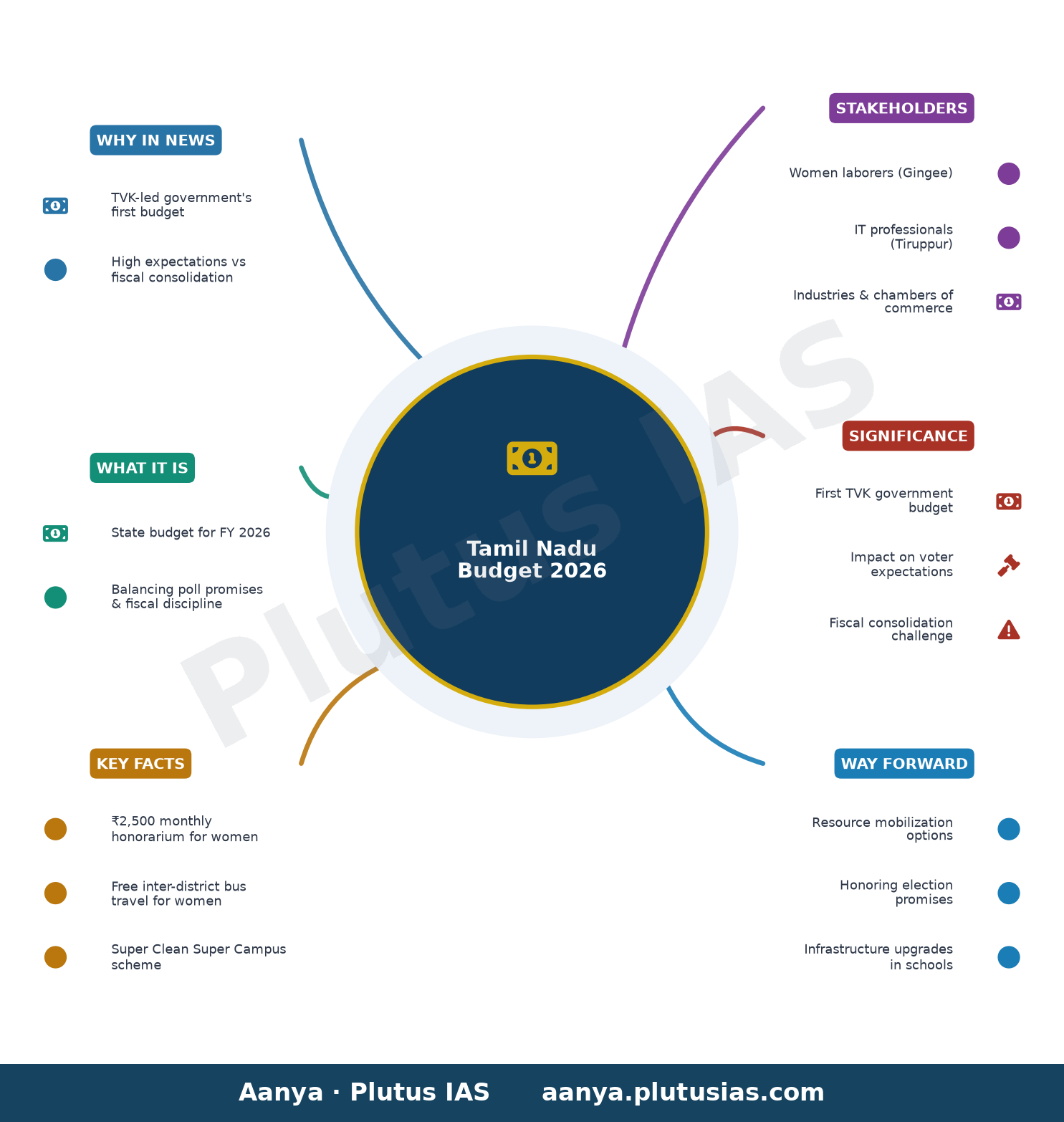
The Tamil Nadu Budget 2026 presents a formidable challenge for the TVK-led government as it grapples with high expectations from voters while ensuring fiscal consolidation. The government faces the dual pressure of honoring election promises, such as increasing the monthly honorarium for women to ₹2,500 and providing free inter-district bus travel for women, alongside the need to address fiscal deterioration. Finance Minister N. Marie Wilson acknowledged the precarious financial state of the state, noting that the treasury is burdened with debt and suboptimal income, requiring at least two years to restore fiscal prudence. This balancing act between populist measures and financial discipline is crucial for aspirants preparing for Banking, SSC, and RBI Grade B exams, as it highlights the complexities of fiscal policy and resource mobilization in a state with diverse economic needs.
The budget’s focus on industrial development and growth has been praised by chambers of commerce, but concerns remain about the sustainability of schemes like the free electricity expansion and crop loan waiver, which are expected to cost nearly ₹7,480 crore. Experts suggest that such measures should be targeted more effectively to avoid overburdening the exchequer. For banking and financial exam aspirants, this scenario underscores the importance of understanding fiscal management, debt sustainability, and the trade-offs between populist policies and economic stability. The budget’s emphasis on reducing leakages and improving resource mobilization also ties into broader themes relevant for exams like RBI Grade B, where candidates are tested on their grasp of macroeconomic policies and their real-world implications.
Source: The Hindu
Generated by AanyaAi for educational purpose.
