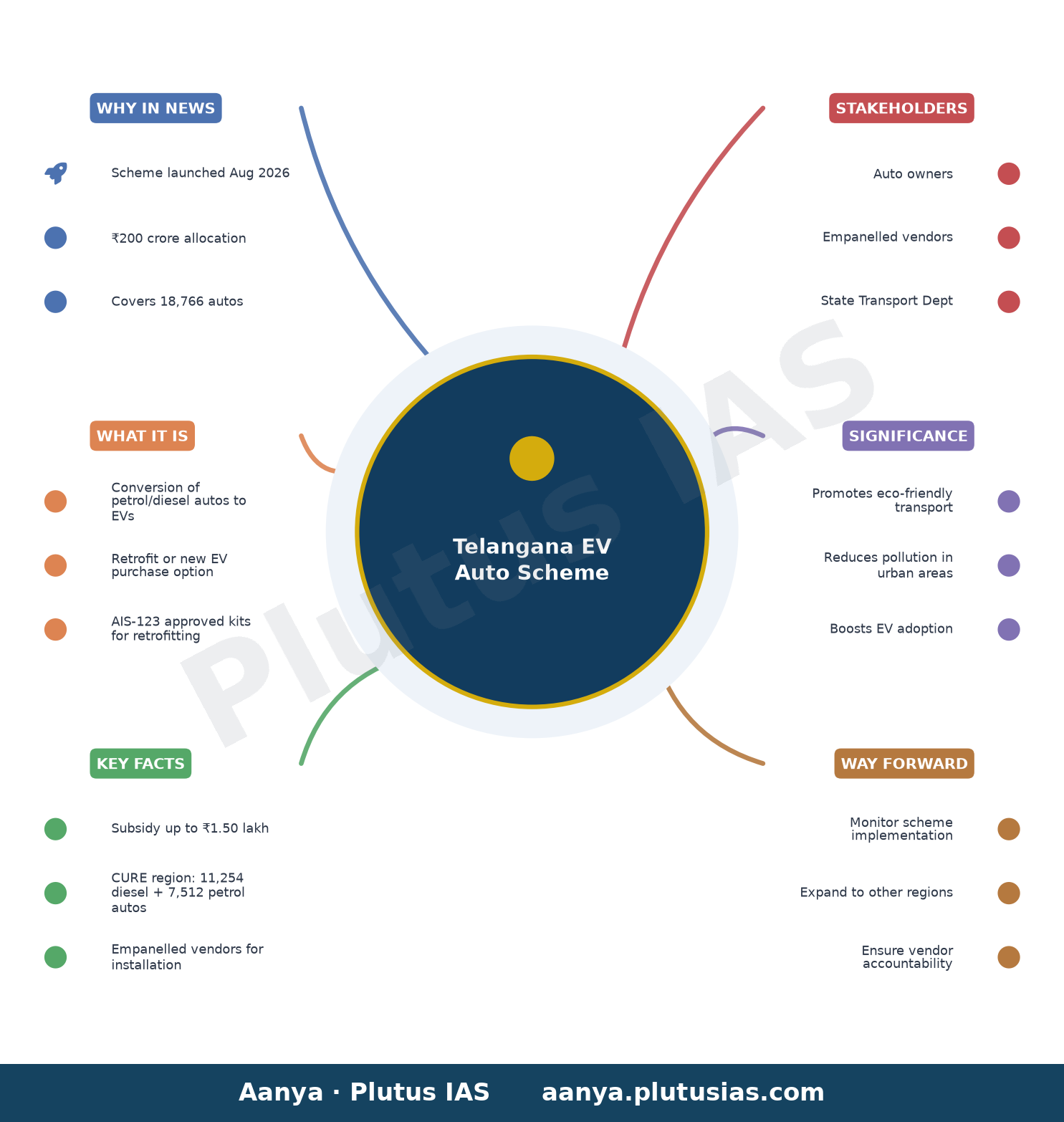
✎ Telangana’s ₹200 crore EV auto scheme aims to convert 18,766 autos to EVs with ₹1.50 lakh subsidy, promoting green transport.
Relevance for Banking, SSC & RBI Grade B exams: Polity & Governance
Telangana’s electric conversion scheme for autos, approved as the Telangana Auto Rickshaw Electric Conversion Scheme 2026, aims to transition 18,766 petrol and diesel autorickshaws in the Core Urban Region Economy (CURE) region into electric vehicles (EVs) with a ₹200 crore outlay. The scheme offers financial assistance of up to ₹1.50 lakh per vehicle, covering either retrofitting existing autos using AIS-123-approved electric kits or purchasing new factory-built electric three-wheelers, with subsidies directly deducted from the final price. The government plans to fund the initiative by allocating ₹50 crore each from the SC, ST, BC, and Minority Welfare Departments, ensuring inclusivity across social categories. A three-tier monitoring mechanism—State-Level Steering Committee, Scheme Implementation Committee, and District Sanction Committee—will oversee execution, aligning with the state’s goal of achieving net-zero carbon emissions in Hyderabad’s urban transport while easing the financial strain on auto drivers amid rising fuel costs.
For aspirants preparing for Bank PO, IBPS, SBI, RBI Grade B, and SSC exams, this scheme highlights key governance and policy initiatives under the Polity & Governance segment, particularly in environmental sustainability and welfare schemes. Questions may arise on subsidy mechanisms, funding sources, or the role of monitoring committees, testing candidates’ understanding of government schemes, fiscal federalism, and sustainable development goals. Additionally, the scheme’s focus on retrofitting versus new purchases could be linked to economic incentives, technology adoption, and employment generation in the transport sector, making it relevant for both prelims and mains examinations.
Source: The Hindu
Generated by AanyaAi for educational purpose.
