
✎ Tobacco Board’s enhanced interest-free loans under Growers’ Welfare Scheme provide financial support to growers for education, healthcare, and disaster recovery.
Relevance for Banking, SSC & RBI Grade B exams: Polity & Governance
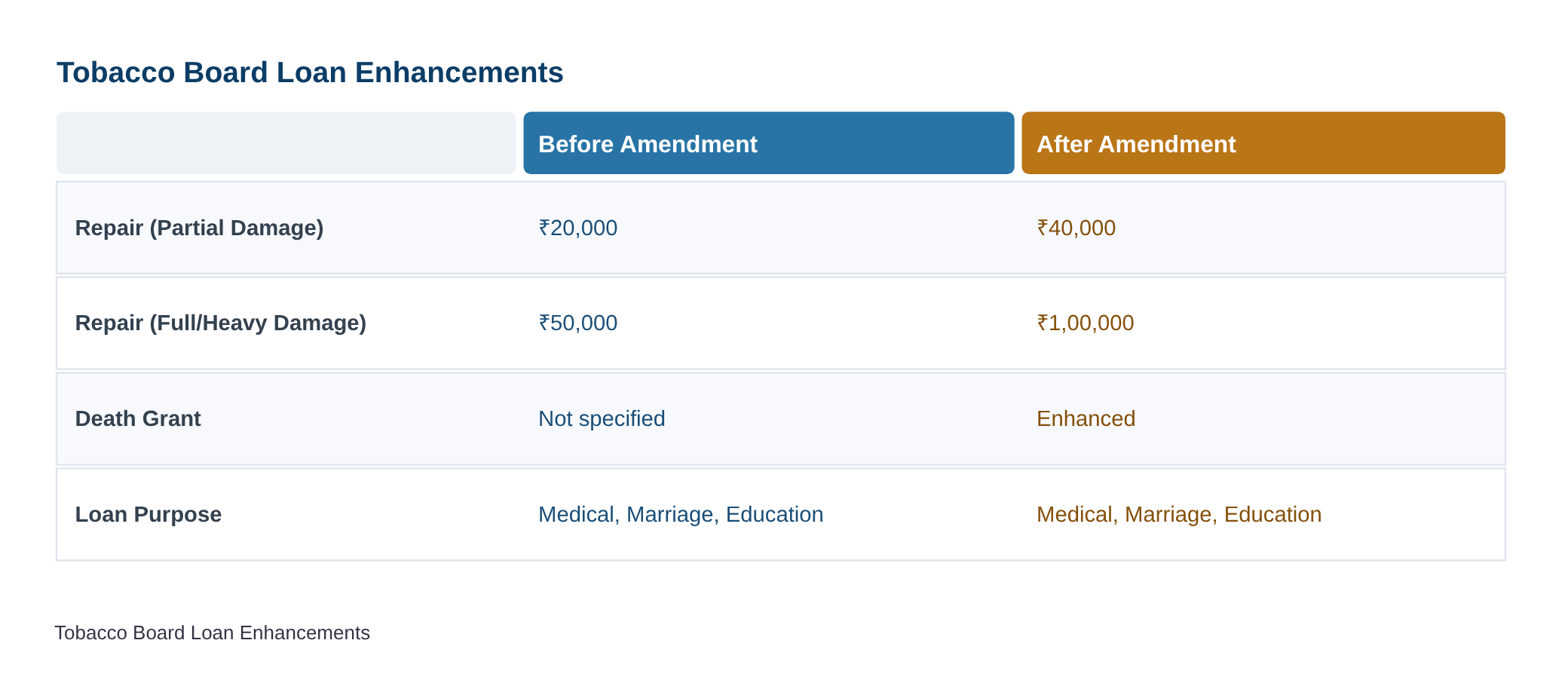
The Tobacco Board’s recent enhancement of interest-free loans under its Growers’ Welfare Scheme, as reported by *The Hindu*, reflects a significant policy shift aimed at supporting tobacco growers in Andhra Pradesh and Karnataka. The government has doubled the loan amounts for critical needs such as medical treatment, daughters’ marriages, and children’s education, raising them from ₹50,000 to ₹1,00,000. Additionally, the death grant has been significantly increased, with natural deaths now eligible for ₹1,00,000 and accidental deaths for ₹2,00,000, underscoring the state’s commitment to social security for agricultural communities. The scheme also addresses infrastructure losses by doubling loan amounts for repairing barns damaged by natural calamities or fire, from ₹20,000 to ₹40,000 for partial damage and from ₹50,000 to ₹1,00,000 for full damage. These measures are particularly relevant for banking and financial governance aspirants, as they highlight the role of quasi-government bodies like the Tobacco Board in implementing welfare schemes that intersect with credit policies, financial inclusion, and rural development. For SSC and RBI Grade B candidates, this policy update serves as a case study in governance, fiscal policy, and the implementation of welfare schemes through specialized boards, which often feature in exam questions on public administration and economic policies.
The amendments to the Growers’ Welfare Scheme also introduce structured repayment schedules, with loans for education and barn repairs recoverable in staggered instalments over three to five years. This structured approach to loan recovery is a key area of interest for banking exams, as it demonstrates the intersection of welfare policies with financial prudence and credit management. The increase in the annual membership fee from ₹500 to ₹1,325 further reflects the Board’s efforts to sustain its operations while expanding its welfare offerings. For aspirants preparing for Bank PO, IBPS, SBI, or RBI Grade B exams, this development underscores the importance of understanding how government and quasi-government institutions design and implement social welfare schemes, particularly in the agricultural sector. Such schemes often form part of the broader economic governance framework tested in competitive exams, making it essential for candidates to stay updated on policy changes that impact rural livelihoods and financial assistance programs.
Source: The Hindu
Generated by AanyaAi for educational purpose.
