
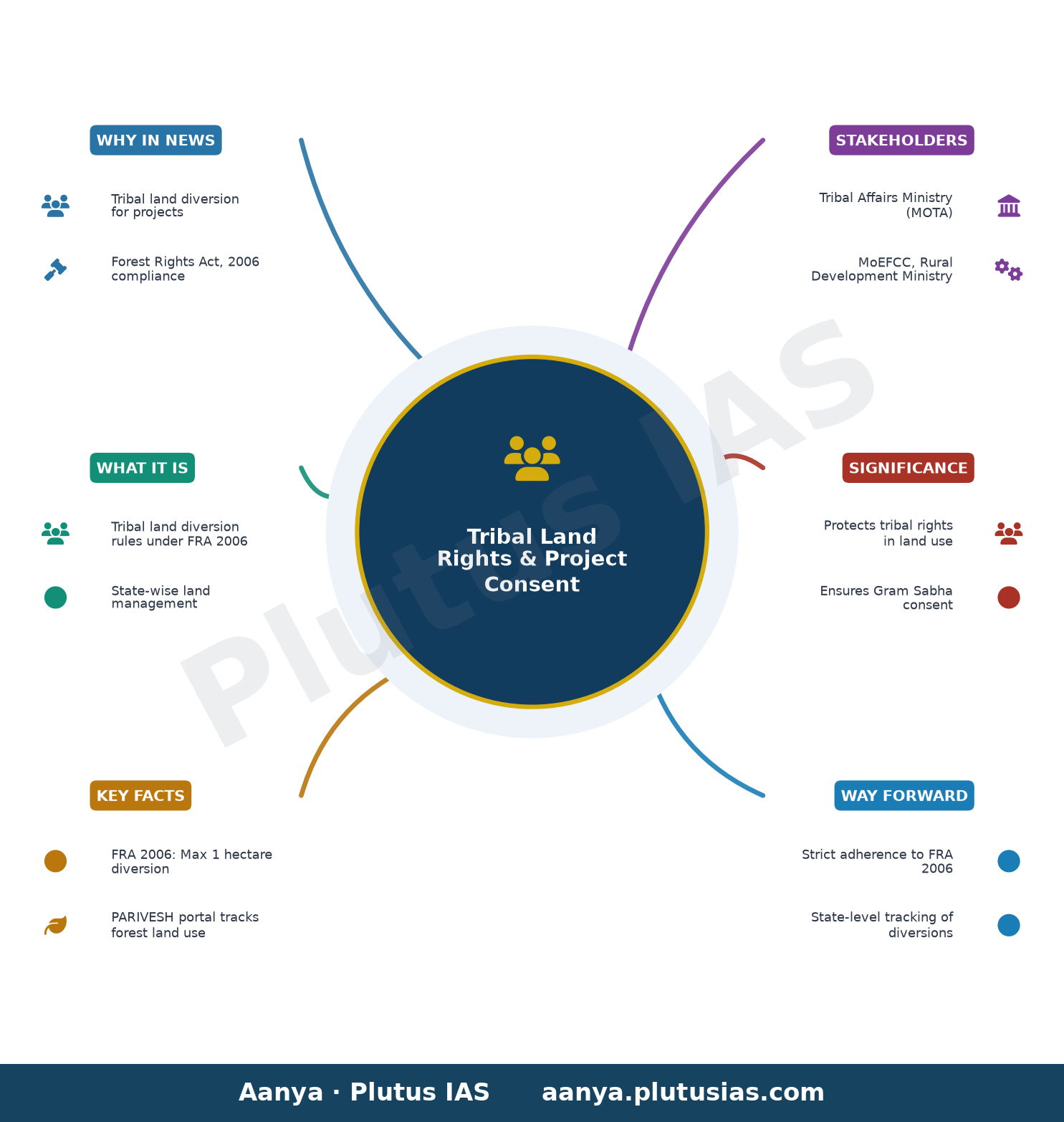
✎ Tribal land diversion for projects requires Gram Sabha consent under FRA 2006 and state-level compliance.
Relevance for Banking, SSC & RBI Grade B exams: Polity & Governance
The recent PIB release highlights the constitutional and legal framework governing tribal land rights and consent in project clearances, a critical issue for governance and policy exams. Under the Seventh Schedule of the Constitution, land management falls under the State List (Entry 18), meaning state governments hold primary authority over land acquisition and diversion. However, the Forest Rights Act (FRA), 2006, mandates that tribal communities’ rights must be recognized and settled before any land diversion, ensuring their consent through Gram Sabhas. The Ministry of Tribal Affairs (MoTA) has emphasized that no tribal should be displaced without proper verification of their forest rights, while the Ministry of Environment, Forest and Climate Change (MoEFCC) processes forest land diversion proposals via the PARIVESH portal, ensuring transparency. This interplay between constitutional provisions, statutory laws, and administrative mechanisms is essential for aspirants preparing for exams like RBI Grade B, SSC CGL, and Bank PO, as it reflects the federal structure of governance and the balance between development and tribal welfare.
For banking and SSC aspirants, understanding these provisions is vital as they often feature in descriptive papers or interviews, especially in the context of sustainable development, land acquisition disputes, and policy implementation. The FRA’s requirement for Gram Sabha consent before land diversion underscores the importance of participatory governance, a concept frequently tested in exams like SBI PO and IBPS. Additionally, the pending legal cases in Odisha, Gujarat, and Himachal Pradesh over tribal land diversion highlight the real-world challenges in balancing infrastructure projects with tribal rights, a topic that could appear in essay writing or group discussions. For RBI Grade B officers, this knowledge is crucial when assessing socio-economic policies or drafting reports on inclusive growth, where tribal welfare and land rights play a significant role.
Source: PIB (Press Information Bureau)
Generated by AanyaAi for educational purpose.
