✎ SASCI scheme funds states to develop globally renowned tourism centers, enhancing infrastructure, employment, and private investment.
Relevance for Banking, SSC & RBI Grade B exams: Polity & Governance
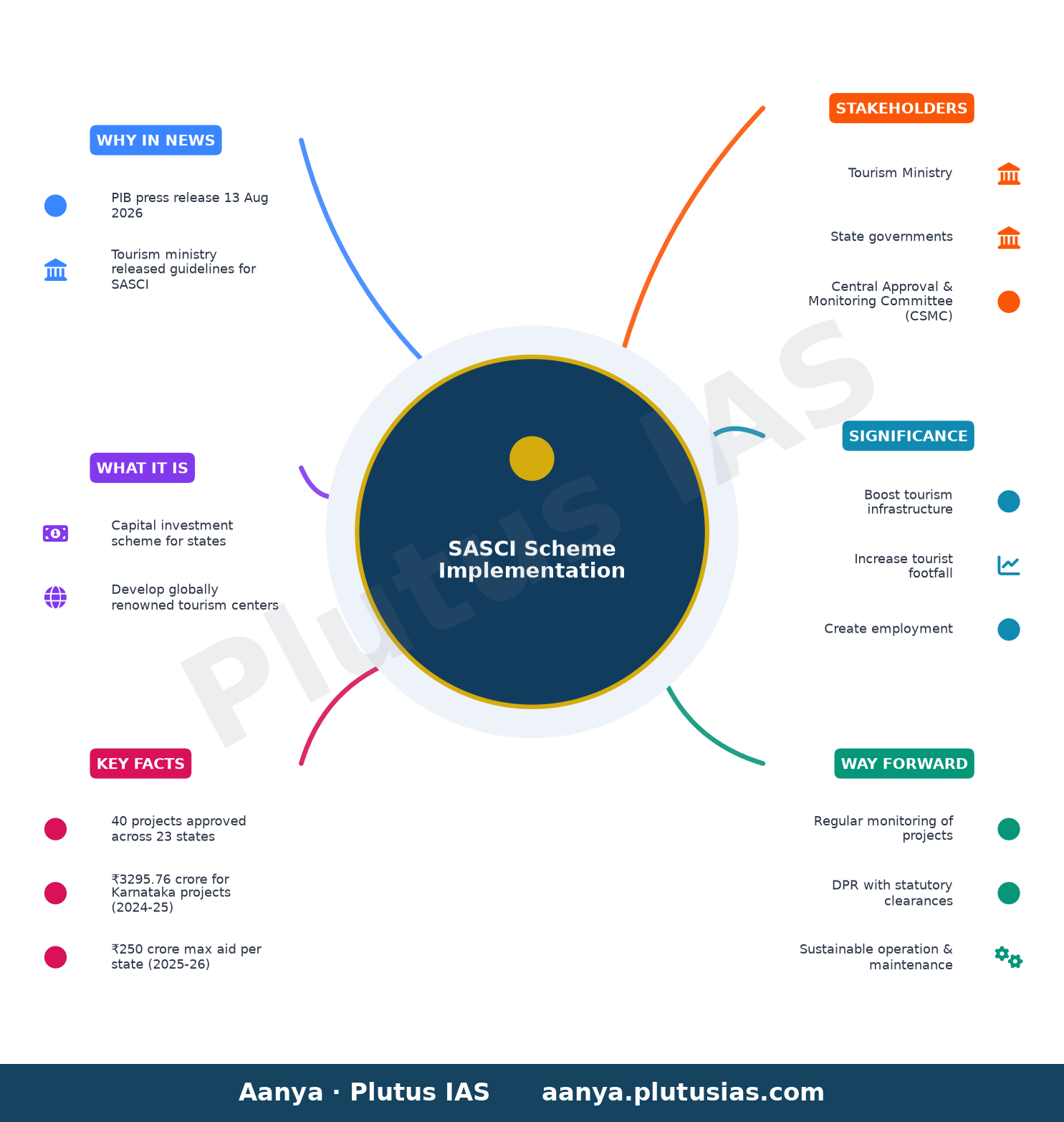
The Union Ministry of Tourism has operationalized the **‘Scheme for Financial Assistance to States for the Development of World-Class Tourism Infrastructure (SASCI)’** to transform India’s globally renowned tourist destinations into high-quality, sustainable hubs. Under this scheme, the ministry has issued detailed operational guidelines and a template for Detailed Project Reports (DPRs), inviting proposals from states for financial assistance. The selection criteria for projects include transport connectivity, existing tourism ecosystem, capacity, service availability, and projected impact—such as increased tourist footfall, higher tourist expenditure, job creation, and private investment attraction. In 2024–25, 40 projects across 23 states were approved, including two in Karnataka worth ₹3,295.76 crore, fully funded by the Centre. Additionally, the Expenditure Department revised the SASCI guidelines for 2025–26, allowing states that missed out in 2024–25 to access up to ₹250 crore each under Part-II of the scheme. Notably, Nagaland, Mizoram, and Himachal Pradesh have each been sanctioned ₹250 crore for tourism projects under this revised framework. The scheme emphasizes multi-level monitoring through a **National Institutional Framework**, including a Central Sanctioning and Monitoring Committee (CSMC) and a Mission Directorate (MD), with representation from key ministries like Civil Aviation, Railways, and Environment to ensure coordinated development. A **Programme Management Information System (PMIS)** has been developed to digitally track project progress, stakeholder consultations, statutory clearances, and sustainability aspects, ensuring transparency and efficient implementation.
For aspirants preparing for **Bank PO, IBPS, SBI, RBI Grade B, and SSC exams**, SASCI is a critical governance initiative reflecting the government’s push for **infrastructure-led growth and employment generation** in the tourism sector. Questions may arise on **scheme objectives, funding mechanisms, inter-ministerial coordination, or digital monitoring tools like PMIS**, which align with the **Government Schemes** section of the syllabus. The scheme also highlights **fiscal federalism**, as it involves **centrally sponsored funding with state-level implementation**, a concept often tested in **Economic and Social Development** segments. Furthermore, the inclusion of **sustainable tourism, eco-tourism, and cultural heritage preservation** ties into broader themes of **sustainable development goals (SDGs)** and **inclusive growth**, making it relevant for **RBI Grade B’s Economic and Social Issues (ESI) paper** and **SSC’s General Awareness** sections. Understanding SASCI’s structure—from DPR evaluation to CSMC oversight—can provide an edge in answering questions on **public policy, governance, and financial administration**.
Source: PIB (Press Information Bureau)
Generated by AanyaAi for educational purpose.
