✎ NAMASTE-SUY scheme empowers sewer workers by providing capital subsidy for mechanized sanitation businesses, ensuring safer and dignified livelihoods.
Relevance for Banking, SSC & RBI Grade B exams: Polity & Governance
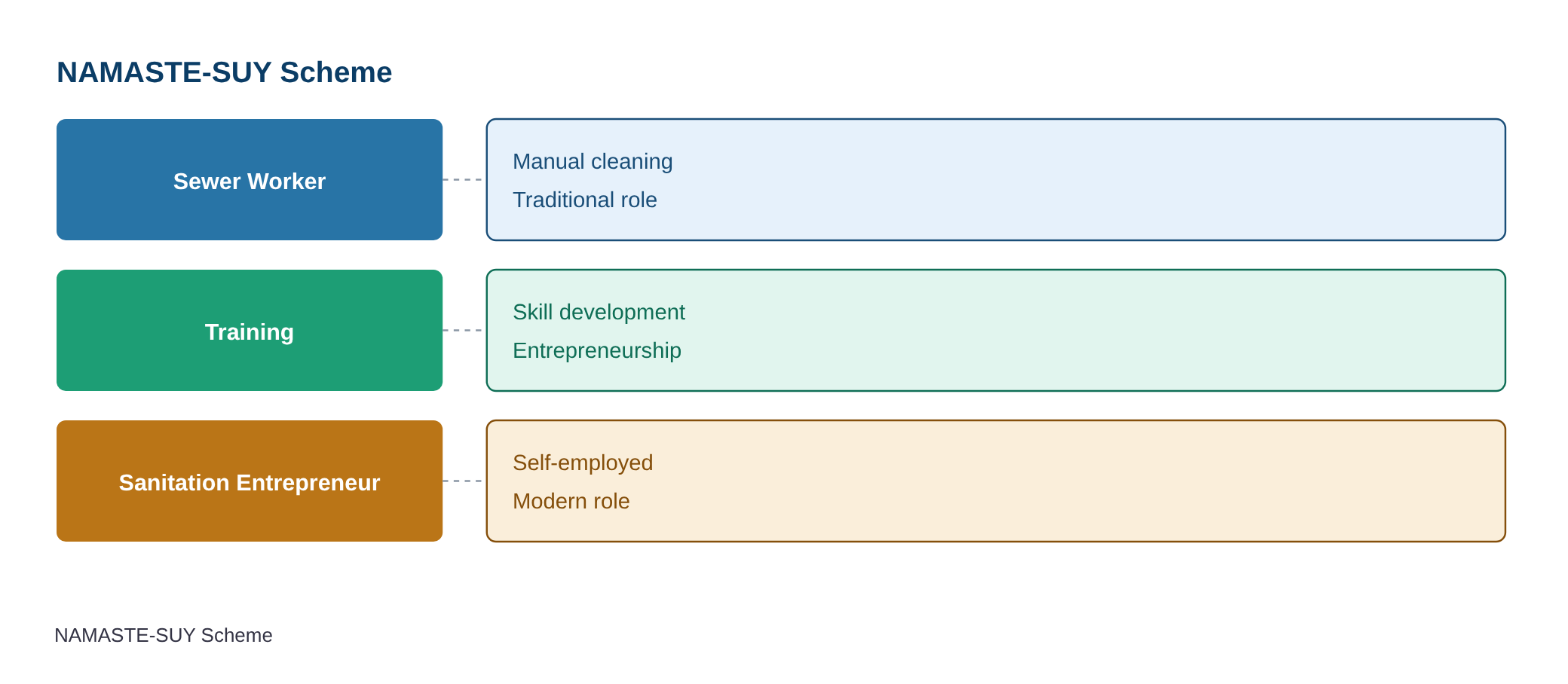
The **NAMASTE-SUY (National Action for Mechanised Sanitation Ecosystem – Swachhta Udyami Yojana)** initiative, launched by the Ministry of Social Justice and Empowerment, has emerged as a transformative policy tool for empowering sanitation workers like **Kailash Chandra**, a 63-year-old manual scavenger from Rajasthan’s Jhunjhunu district. Facing systemic barriers such as caste-based discrimination, limited education (up to Class 6), and hazardous manual labor with irregular income, Chandra’s journey from a sewer cleaner to a mechanized sanitation entrepreneur underscores the scheme’s role in promoting **self-employment, financial inclusion, and dignity**. Under NAMASTE-SUY, he received a **50% capital subsidy (₹5.93 lakh)** and a **₹5.93 lakh loan** to purchase a suction machine-equipped tractor, enabling him to establish a mechanized sanitation business. This shift not only improved his monthly savings (₹8,000–10,000 post-expenses) but also created employment for two others (driver: ₹12,000; helper: ₹8,000 monthly), aligning with the scheme’s broader goals of **reducing manual scavenging, formalizing sanitation work, and fostering entrepreneurship** among marginalized communities. For banking and SSC aspirants, this case highlights the **intersection of social welfare schemes with economic mobility**, while RBI Grade B candidates should note its relevance to **financial inclusion policies** and **targeted subsidies** as tools for reducing poverty and informal labor.
The NAMASTE-SUY model exemplifies how **policy interventions can convert high-risk, low-productivity jobs into sustainable livelihoods**, a critical lesson for governance and public administration examinations. For **Bank PO/IBPS/SBI aspirants**, understanding such schemes is vital as they reflect the government’s commitment to **skill development, MSME promotion, and inclusive growth**—key themes in banking exams’ economic awareness sections. Similarly, **SSC CGL candidates** may encounter questions on **government welfare programs** or **case studies of social empowerment**, where NAMASTE-SUY’s structured approach (subsidy + loan + training) serves as a benchmark. RBI Grade B candidates, particularly in **Phase II (Economic and Social Issues)**, should analyze the scheme’s **fiscal implications** (subsidy burden, loan repayment models) and its role in **formalizing the sanitation sector**, which remains a priority under India’s **Swachh Bharat Mission 2.0**. The case of Kailash Chandra thus bridges **polity, governance, and economic policy**, making it a high-yield topic for competitive exams.
Source: PIB (Press Information Bureau)
Generated by AanyaAi for educational purpose.

1 comment on “NAMASTE-SUY Scheme Empowers Ex-Sewer Worker to Become Entrepreneur”