
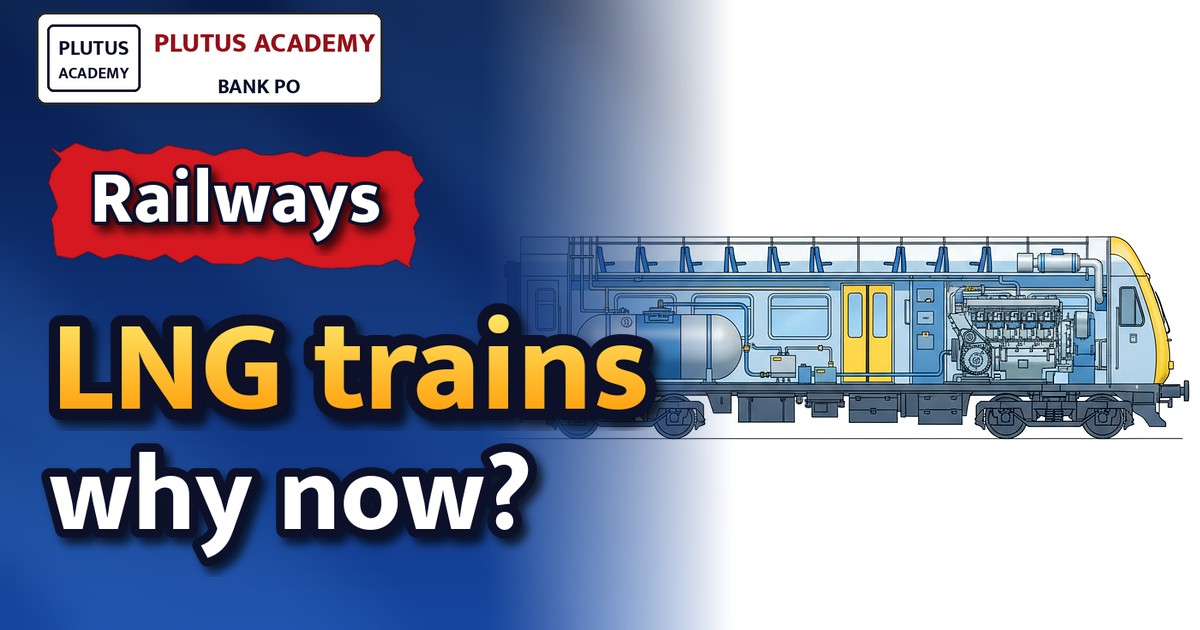
✎ LNG trains are a dual-fuel solution for DEMUs to cut emissions where electrification is impractical.
Relevance for Banking, SSC & RBI Grade B exams: Environment
The Indian Railways’ recent launch of the country’s first liquefied natural gas (LNG) train—a modified diesel-electric multiple unit (DEMU)—raises questions about its necessity despite the near-complete electrification of the network. While 99.6% of the broad-gauge network is electrified, DEMUs operate without separate locomotives, using built-in power packs in driving power cars (DPCs) to generate traction. Since these trains cannot be hauled by electric locomotives, converting them to dual-fuel LNG-diesel systems offers a practical solution to reduce emissions without retiring functional assets. The move aligns with India’s decarbonization goals, as LNG emits up to 30% less CO₂ than diesel, while retaining operational flexibility for emergencies or non-electrified routes.
For banking, SSC, and RBI Grade B aspirants, this development highlights key themes relevant to economic and environmental policies. The Railways’ shift to LNG underscores India’s broader push for cleaner energy in public transport, a sector critical to sustainable infrastructure—often tested in exams through questions on government schemes or climate initiatives. Additionally, the financial aspect—such as the Rs 1.86 crore conversion cost and potential export opportunities—reflects the intersection of fiscal prudence and green technology, a recurring topic in banking awareness and economic surveys. The dual-fuel DEMU’s adaptability also mirrors broader themes of asset optimization and technological innovation in public sector undertakings, frequently featured in SSC General Awareness and RBI Grade B’s economic and social issues sections.
Source: The Indian Express
Generated by AanyaAi for educational purpose.

2 comments on “Why Indian Railways Launched LNG Trains Despite Full Electrification?”